FUEL PRICE INCREASES
“They are in a place of luxury. That’s why they don’t think about our misery, hunger, or the cost of the basic food needs of the working class.”
There is a lot of underreported anger directed against the U.S. in countries around the world. Massive protests and transportation strikes have erupted across Europe, Asia, and Latin America linking the U.S. military action in the Middle east to worsening domestic poverty and hunger.
OUR VIEW
Recently, President Trump has begun to make the argument that the increase in fuel prices at the pump for Americans is a small price to pay in order to prevent Iran from ever having a nuclear weapon. You may agree or not, but the implication is that these increased costs of war are a burden that Americans need to bear.
I am guilty of thinking provincially. I imagine most of us are.
When I look at issues I tend to view them through the lens of how it affects me, or how it applies to my hometown, state or country. Generally, the scope of my view is restricted in that way. That is not to say that some issues are world-wide, but my initial reactions tend to be limited.
I mention this because almost all of the articles, posts, columns, and conversations about fuel price increases are restricted to how they have affected the American Consumer and our economy. Mr. Trump’s comments focus us on our increased cost burden, almost as if they are limited to the US only.
But clearly this circumstance is not restricted to the US. The costs of fuel have also increased across the world. This is a direct result of several factors.
First, the fuel industry, including discovery, production, shipment, refining, distribution, and sales have been concatenated into a small group of multi-national conglomerates. This levels pricing and costs across the entire planet.
Second, the ability for individual countries to supply their own citizens with gas or diesel is limited by the types of oil they can produce, the local facilities they have for processing the different types of oil, and the capabilities they have to import, store, and distribute the end products to the consumers.
Third, the ability of governments to offset increasing fuel and fertilizer costs through reduced taxes and/or subsidies strains budgets that are already running deficits.
Finally, the Iran War’s effects have been measurable over the past 8 months.
INCREASES IN FUEL AND FERITILIZER COST IN OTHER COUNTRIES
I don’t think anyone would be surprised to find that the price of gas and diesel has increased across the globe since January of this year, primarily due to the US/Iran war and the resultant restriction in oil distribution. These increases are independent of any effects of the Russia/Ukraine war. Increased prices from that conflict have been absorbed over the past four and half years of that war.
I have spent some time looking at a select group of countries to try to understand how prices have increased globally. This note will examine some of what I have found.
I looked at 8 countries around the world, plus the USA to see what effects the Iran War has had on gas and diesel prices for consumers.
Now, if you want to compare the increase in prices of the fuel, you have to make an adjustment for the taxes imposed on those items. There are two types of taxes on fuel. One tax is a fixed excise tax per gallon. This amount stays constant independently of the variable price of a gallon (or liter) of gas or diesel. The other tax is a sales tax that is a fixed percentage of the sale. Sales Taxes or VATs have no effect on the percentage increases as they apply in all cases and scale up and down with prices.
To give you an example of why fixed taxes affect the increased costs, consider two countries:
In Country A there is no tax on gas
In Country B there is a $1.00 per gallon excise tax on gas.
If the cost of gas is $1.00 per gallon, then in Country A the consumer pays $1.00 per gallon.
In Country B the consumer pays $2.00 per gallon (the $1 cost plus the $1 tax).
Consider what happens when the cost of the gallon of gas goes up to $2.00.
In Country A, the consumer pays $2.00 per gallon, a 100% increase in price.
In Country B the consumer pays $3.00 per gallon (the $2.00 plus the $1.00 tax). The net result in Country B is a 50% increase in price.
Every country has different taxes on gas and diesel.
For example, in France there is a fixed tax of 0.683 Euros on each liter of gas sold, plus a VAT of 20%.
In South Africa, there is a fixed tax of 5.59 Rand per liter, but no VAT or sales tax.
In Australia, there is a fixed tax of Australian $0.53 per liter and a VAT of 10%.
Here in the US, there is no sales tax, but there are fixed Federal and State taxes that average about $0.54 per gallon.
To compare the increase in fuel costs between countries, you first need to subtract the fixed and variable taxes that are added on to the gas sold. In some countries, like Venezuela, there are Government subsidies that reduce the cost of gas to individuals. I have not included those countries in this analysis. All 9 countries that I examined have no governmental subsidies on the sale of gasoline or diesel.
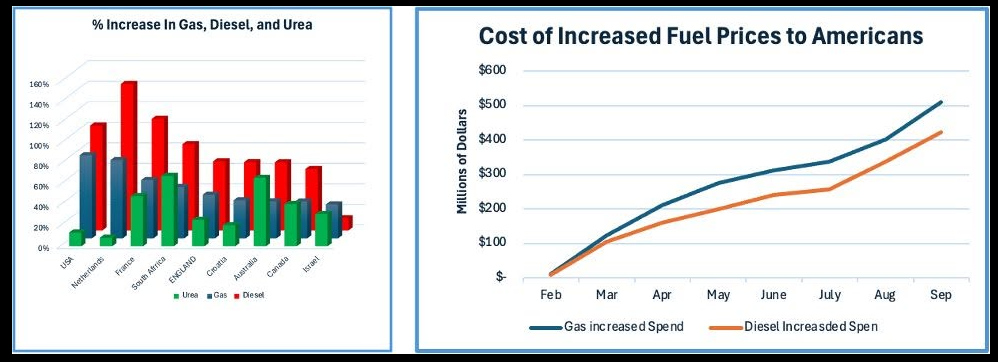
So, what do we see? The Chart on the left shows the relative increases in costs of gas, diesel, and Urea (fertilizer) for consumers today compared to January of this year:
As you can see from the chart, all of the countries that I looked at had increases in the price of fuel over the past 9 months. For gas, all of the countries had increases in prices, but all had increases that were lower than those seen in this country. With respect to diesel, several countries had increases greater than those seen in this country. And for Urea, the cost increases in the US were below those of the other countries.
The effects of the Iran War have been felt around the globe. This is mirrored in the inflation numbers for all of these countries. All of the countries had inflation rates in August comparable to that of the US (3.4%) with the exceptions of South Africa, whose inflation was 4.3% and Israel whose inflation was only 1.5%.
The Chart on the right shows the increased spend that Americans have had to make over the months since the start of the Iran War on Gasoline and Diesel. The chart shows the increases for each month, not the accumulated total of increases. As the prices of gas and diesel have increased, the costs have increased each month. The total amount added to the American’s budgets is about $4 billion.
I think it becomes clear when viewing this data, that the entire planet is paying higher amounts for fuel and fertilizer than before the Iran War began. And in Mr. Trump’s telling, everyone in every country is contributing to the costs of the war.
The question that seems particularly relevant is, “How do other countries view the US today, through the prism of increased fuel and fertilizer costs due to the specific actions of the US this year?” Although not prominently reported in this country, citizens in countries across the globe are furious and are protesting the increased prices, blaming the U.S. and its war with Iran with the increases in fuel and fertilizer, and increased inflation.