INCREASING IMMIGRATION FOR PURELY SELFISH MOTIVES
One of the undiscussed issues pertaining to immigration in this country is our declining Birthrate. Why?
In 2025, according to the U.S. CDC, the Birthrate in the U.S. population reached a low of under 54 births per 1,000 women aged 15-44. This corresponds to a “Fertility Rate” of 1.6 children per woman.
To maintain a population, the Fertility Rate needs to be at least 2.1 children per woman. Numbers lower than that result in a decrease in the population over time.
In 1920 the Fertility was 3.3 children per woman
In 1930 the Fertility was 2.5 children per woman
In 1940 the Fertility was 2.0 children per woman
In 1950 the Fertility was 3.0 children per woman
In 1960 the Fertility was 3.7 children per woman
In 1970 the Fertility was 2.4 children per woman
In 1980 the Fertility was 1.8 children per woman
In 1990 the Fertility was 2.1 children per woman
In 2000 the Fertility was 2.1 children per woman
In 2010 the Fertility was 1.9 children per woman
In 2020 the Fertility was 1.6 children per woman
In 2025 the Fertility was 1.6 children per woman
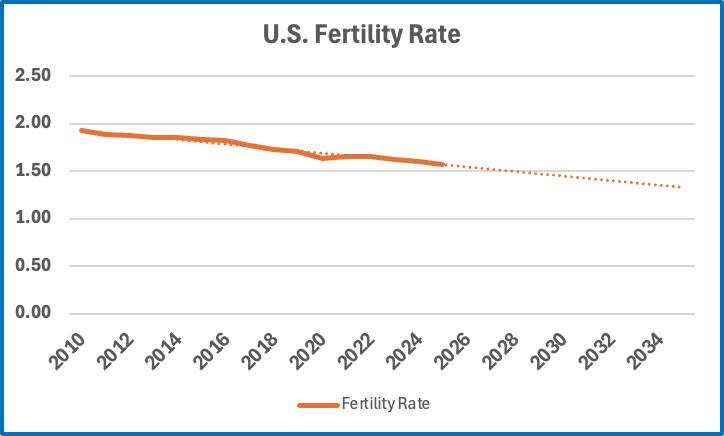
The current birth rate in the U.S. is the lowest in the history of this country. And the trend over the past 15 years is quite clear (data from Pew Research):
If the current trend continues, the U.S. Fertility Rate will fall under 1.4 by 2035.
One reason for this decrease is a trend among women to delay having their first baby. In 1970 the average age of a woman giving birth for the first time was 21. In 1990 it increased to 24, and today it is almost 28. The average age for a woman getting married has parallelled the age of first births - delayed marriage results in delayed childbearing, and delayed childbearing reduces the time span for building a family.
The economics of raising a child has also played a part in the decreased birth rate. According to the U.S. Bureau of Labor Statistics, the inflation-adjusted costs of raising a child through the age of 17 has increased by 150% since 1998. These costs include groceries, kids’ apparel, infants’ and toddlers’ apparel, footwear, day care and preschool, fees for lessons or instructions, and medical services including primary care, dental, and vision. (They do not include college or post-high school education). Whether you personally believe that these expenses are necessary or not, they weigh on the decisions of families to have children and on how many to have.
LOW BIRTH RATE EFFECTS
What are the effects of a low birth rate to a country?
Let’s look at the repercussions of a declining birth rate.
HEALTHCARE
When less people are born, the average age of the population increases. An aging population requires increased healthcare expenditures, as most healthcare costs occur near the end of life. According to numerous studies, adults over 55 account for almost 60% of all health care spending even though they represent only 30% of the population.
PENSION COSTS
An aging population requires increased spending on pensions including social security. More beneficiaries coupled with fewer workers strains the system.
WORKFORCE REDUCTION
Fewer people entering the workforce results in fewer active workers. This reduces tax revenues.
Decreased skilled workers reduces the ability to innovate and reduces technological progress and economic output.
This is compounded by the need for workers in home healthcare, nursing, agriculture, and food processing, jobs that have been traditionally filled by new immigrants and for which domestic labor is difficult to obtain.
CONSUMER DEMAND
A shrinking working-age population reduces spenders and savers. In a consumption-driven economy such as that in this country, reduced consumer demand will reduce GDP, company profits, and economic growth.
If we want to keep our population stable we need to address the Birth Rate.
We cannot legislate people to have more children. We might supplement the costs of raising a child, but our current political atmosphere is not conducive to adding new “welfare” programs. Social pressure, religious teachings, and public advertising can have some effects, but the trends are almost immutable.
With the current birth rate, 3.6 million babies will be born in the U.S. this year. This means that we will be short 1.1 million babies this year to maintain our population and our economy.
The easiest way to replace that needed population is to increase the numbers of immigrants that we admit to this country.
Simply for our own selfish economic motives, we need to increase immigration.
We can do that without sacrificing safety and security. We need to expand the criteria for which we allow immigrants to apply for asylum. We can vet those at the border crossings and with subsequent investigations to filter out violent criminals and drug dealers. We can allow people who have left their countries to seek safety from gangs, from political repression, or for economic reasons to apply for asylum in the U.S. and we can provide them with a clear path to citizenship over a period of time, say 10 years. If they are not convicted of a crime (except for minor offences like traffic violations), if they remain gainfully employed for the majority of that time, if they learn to speak, read, and write English, and if they can pass an exam demonstrating at least a 6th grade level of understanding of U.S. civics and history, they should be given full citizenship.
These rules would encourage families to immigrate here. And it is precisely those families that are the solution to our declining Birthrate problems.
Providing clear and safe ways to immigrate to this country will reduce illegal immigration, undermine human trafficking and make our system far more efficient and manageable