All news this month is not bad. Sometimes there are actually encouraging signs. This is the situation now at the beginning of October.
I want to take this opportunity to report on two positive signs with respect to the virus.
The first is the continuing death rates.
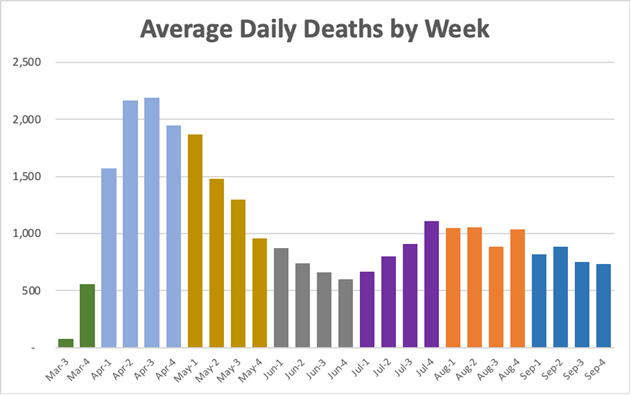
Now, I do not celebrate ANY deaths. This country still ranks in the top two or three in the world with respect to new deaths per day, and #1 in total deaths. However, within our country the data is moderately encouraging. Here is the chart that we have been following for the past few months:
The average daily death rate by week during the month of September has fallen with respect to August and appears to be trending down since the end of August. We won’t know the factors influencing this for several months; it may be due to decreased cases and hospitalizations, or it may be due to an increasing ability of the medical community to treat the disease and reduce the lethality.
I will continue to follow this data and, hopefully the death rates will continue to decrease.
The second piece of data is the positivity rates across the country. Here is the data:
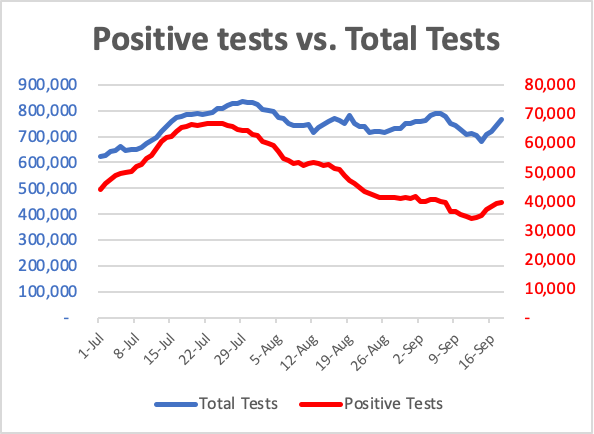
As we have seen in the past, testing has not significantly increased over the past month, still lagging behind the highest levels achieved in July. However, the final few weeks of September appear to suggest that testing is now ramping back up. We can hope that these trends continue.
The important observation is that even with stable testing, the positivity rates have been dropping. The gap between the two curves is increasing. This is encouraging information. It MAY mean that infection rates are decreasing, resulting in lower detection of positives as a fraction of tests performed.
On the other hand, It MAY mean that the testing universe is now including more individuals with a lower likelihood of being infected than previous months in which testing was generally restricted to patients either showing symptoms or at high risk of having been recently infected. A widening in the criteria for testing would mathematically push the positivity rate down.
Or, on the third hand, it MAY mean that some of the areas of the country are doing better than they were last month due to their increased restrictions, while other areas are not, the combination of the two resulting in overall decreased positive testing.
This is the basic problem with testing data. We don’t know how to compare one week to another as the populations that are being tested are not controlled, nor are the types of testing platforms controlled, nor is the status of the patients. Nevertheless, this is an encouraging piece of data.