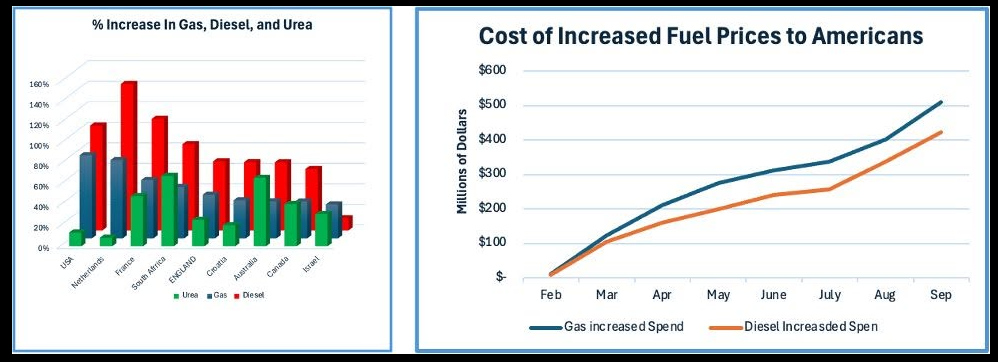
Media coverage of the strains on the economy resulting from the Iran War seem to focus on fuel prices. And this is clearly important as fuel costs impact the family automobile budget as well as the national costs of transporting anything from one place to another, whether that is a load of toys, a load of lettuce, or a planeload of people.
THE WORLDWIDE OIL MARKET
Even though the U.S. produces sufficient oil for our own use, we need to import oil. Why?
Since the 1990’s there has been tremendous consolidation in the oil industry, beginning with the rise of the Supermajors through mergers of Exxon with Mobil, BP with Amoco, Chevron with Texaco, and Conoco with Phillips.
During the 2010’s further consolidation occurred with Supermajors purchasing independent producers such as shale and natural gas companies.
And since 2023 mega-deals have surged over 300% with such mergers as Exxon with Pioneer, and Chevron with Hess. While there were 50 publicly traded U.S. producers in 2024, there are only 40 today.
The net result is the creation of multi-national oil companies that price their products based on worldwide markets, not local markets. This is why fuel prices in the U.S. have risen recently although we claim to be able to produce sufficient oil for our own use.
So, why do we need to import oil?
For several reasons, but the main one is that oil in one place is not the same as oil in another. The oil produced in the U.S. is referred to as “Light Sweet”, while the imported oil from Saudi Arabia, for example is “Medium Sour”, and that from Mexico, Canada, and Venezuela, for example is “Heavy Sour”. These designations refer to the density (how thick the oil is) and how much Sulfur is in the oil These characteristics are extremely important because the technology needed to refine each type of oil is different.
In general, the Medium and Heavy oils are less expensive than the Light oils, and when processed into diesel, jet fuel, tar, and asphalt, generate higher margins for the processors. The plants that do this refining are set up to handle the heavier oils and CANNOT process the Light Sweet oil primarily produced in the U.S. And the bulk of the plants in the U.S. are designed to process these heavier oils. For those plants to be refitted to process the Light Sweet oil would shut them down for years and require multi-billion-dollar investments for those upgrades. New plants constructed to handle the Light Sweet oil would take much longer to be approved, designed and constructed, and cost even more.
The net result of this is that fuel prices are set by the worldwide network of producers, shippers, refiners, and distributors and are not tied to any local markets.
The general take-home message here is that we are part of the global production system. We export what we cannot refine, and we import what we need.
As Gertrude Stein might have said, “Oil is not oil is not oil”.
THE WORLDWIDE UREA MARKET
Using that as a basis, let’s take a look at Urea, the most-used form of fertilizer. The U.S. produces about 60% of the Urea that U.S. farmers need, and imports about 40%. And about 30% of those imports come from the Persian Gulf which produces about half of all Urea made worldwide. And, like all other global resources, the price of Urea fluctuates globally not locally.
Because U.S. farmers get close to 90% of their Urea from sources outside of the Persian Gulf, there is little likelihood that those farmers will be unable to fertilize their crops this year. But the longer that the Strait of Hormuz remains shut, the more difficult it will be for other countries to obtain the Urea that they need, and they will attempt to divert supplies from other countries to theselves, making the U.S. access to those offshore producers more difficult, and certainly more expensive.
The worldwide price of Urea rose from $440 per metric ton in February of this year to almost $800 per metric ton now, primarily due to the Iran War.
Note: for those of you not familiar with the term “metric ton” (sometimes referred to as “a tonne”, it is the metric weight measure of 1,000 kilograms, whereas the “imperial ton”, the measure that is most common in this country, is measured at 2,000 lbs. The difference is that the “tonne” is equal to about 2,205 lbs. or is 10% heavier that a “ton”. This is similar to the difference between a “yard” and a “meter”.
Most international statistics are in tonnes, so that is what I will use for the calculations below.
Urea is a solid powder. Therefore, it cannot be moved through pipelines; it must be shipped in containers as cargo freight on transport vessels. The Urea currently being produced or having been produced in the Persian Gulf is immobile in the Gulf due to the closure of the Strait of Hormuz. Stockpiles at production plants are full and production has been slowed if not stopped. Without incoming empty freighters, Urea cannot be offloaded from the manufacturing plants. And any military action against natural gas facilities in any of the Gulf countries will further reduce the ability to produce Urea.
THE NET RESULT OF THE IRAN WAR ON UREA COSTS TO FARMERS
I will layout the calculations of what the costs are below; but, because those calculations are pretty thick, here is the basic conclusion:
- The landed cost of enough Urea to fertilize 1 acre of farmland growing soybeans or corn has increased from $83 in January of this year to $142 today.
- That represents an increase of $59 per acre, or 72%
Those increases can be expected to be felt in increased food prices over the next few months, and since any recovery of the production facilities and shipping routes from the Persian Gulf will take months, if not years, to resolve, we can expect those food price increases to be maintained for quite a number of planting/harvesting cycles, not only in the U.S., but around the world, and those shortfalls cannot be “made up” after the Urea comes back on line. The loss of a planting season cannot be recovered.
Gas prices for you family car may fall in a relatively short period of time, the effects on food production will last for years.
ADDITIONAL COSTS TO U.S. FARMERS
Now let’s take a look at the additional costs that U.S. farmers must absorb from the current increases in Urea and oil.
Current freighters can carry about 46,000 tonnes (metric tons) of fertilizer.
Each freighter can carry about 1,500 40’ containers of Urea. The cost of shipping each container from the Persian Gulf to the U.S. Gulf states is about $2,500. Each container can carry around 30 tonnes of Urea, so the cost of transporting it to the U.S. would be about $83 per tonne.
For the sake of this discussion, we will not attempt to assess the increased costs of shipping a container, but we do recall that during the COVID 19 pandemic, and with ships collecting at ports, the price of shipping by sea rose from about $2,500 per container to over $20,000 per container.
So just including ocean costs, the price delivered to the U.S. was $440 + $83 = $523 in January; but it is $800 + $83 = $883 today.
But volatility due to the Iran War has raised insurance costs and availability issues, resulting in a $400 surcharge per container from the Persian Gulf states today. Each container of Urea today will cost $400 more to ship simply based on the insurance costs. And for shipping each 30 tonnes of fertilizer, that adds a cost of at least $13 per tonne. That raises the cost of Urea today from $883 to $896.
These freighters use heavy bunker fuel to power them (different from diesel). That fuel has risen from about $456 per tonne in February to $1,057 per tonne today.
That freighter would use about 3,200 tonnes of fuel to travel from the Persian Gulf to the U.S. Gulf Coast.
3,200 tonnes of fuel to transport 46,000 tons of fertilizer. That comes out to about 0.07 tonnes of fuel per tonne of fertilizer. And where the cost of that transport in February would have been $32, today it is $74, raising the price of each tonne of fertilizer by $42.
This raises the price of a tonne of Urea delivered to the U.S. today to $938.
Once delivered to the U.S. port, the containers of Urea need to be shipped to the farms in the mid-west.
Each standard 40’ shipping container can hold about 30 tonnes of Urea. And shipping a container from New Orleans to Chicago usually costs about $2,500.
That adds an additional $83 per tonne of Urea delivered to the farm, raising the costs as of January from $523 to $606 per tonne and for today from $947 to $1,021.
But that truck uses diesel fuel, and diesel fuel has increased from $3.50 per gallon in January to over $5.64 today. Each truckload (container) uses about 145 gallons of fuel for the trip, and therefore the fuel surcharge for the increased cost of fuel is currently about $310 per container, or $10 per tonne (an INCREASE of $10 per tonne).
Considering the transportation costs of the container from the port, and the additional fuel costs, our cost of Urea delivered to the farm has now risen from $523 in January to $1,031 today.

Now, the Urea is at the farm. It has to be spread over the soil.
The typical fertilizer spreader will use about 1 gallon per acre. The increase in diesel costs from $3.59 to $5.64 has added about $2 to the cost of spreading the Urea.