I have been struggling for several months with attempting to understand the value of having banned travel from China into the USA at the beginning of February, and its effect on COVID-19 infections in this country.
As with all my previous essays, I do not want to discuss the political issues surrounding this decision. Those points may be debated among others.
My perspective on the ban is to try to understand how it affected the course of disease and whether it is possible to understand how those effects would have occurred.
To understand my difficulties in understanding claims that banning travel from China saved lives in this country, I am confronted with the following analogy: We have discussed in previous essays the concept of “viral load”. To recapitulate, there is a well-studied and documented tipping point at which an individual can become infected. If you are in contact with an infected individual and exposed to virus particles from that person, but you only inhale a few hundred viral particles (virions), you will NOT become infected. Research has shown that for COVID-19, the tipping point for viral load is somewhere around 1,000 virions. If you are in contact with a contagious individual, at close enough distance to be exposed to shed virus, for sufficient time to have 1,000 virions transmitted to you, you will have very high probability of becoming infected.
Of course, these numbers are statistical values. It is not that if you only get 999 virions that you WON’T get infected. The numbers are statistical. Less than 1,000 particles, your likelihood of infection is low, above it is high.
Now, to understand the conundrum here consider the following. If you are exposed to an infected individual for sufficient time and have 1,500 virions transmitted to you, you will most likely become infected. But what happens if you get exposed immediately thereafter to another infected person and get an additional 1,500 virions transmitted to you? Will you become more infected? NO. Once you reach the tipping point, the infection is active; adding additional virus particles has no additional repercussions.
This has been my problem in looking at the China ban. In January, the virus was already here. In February, almost every state in this country was already infected. There were cases across the country and within 4 weeks, as would be predicted, we began to see deaths. We have discussed this 4-week lag on multiple occasions. So, what did the China ban do if this country had already crossed its own viral load tipping point?
The ban on travel may have decreased the rate of spread of the disease, but not the disease itself. The increased time created by this decreased rate of spread may have contributed to “bending the curve”, but I have trouble understanding how it could have saved lives.
IS THERE A METRIC TO LOOK AT TO SEE HOW THE CHINA TRAVEL BAN AFFECTED DEATHS?
Yes, there actually is.
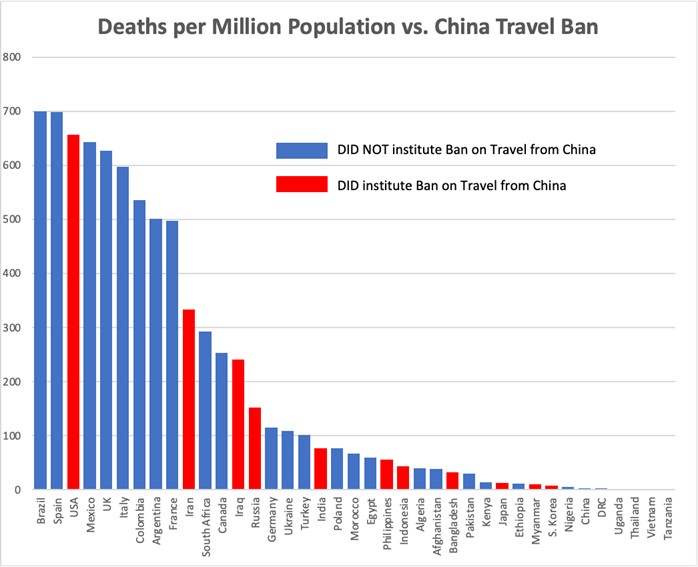
I have tabulated data from the world and that data is shown in the graph attached. I looked at every country in the world with a population of greater than 35 million. (I chose that number, because it includes most of the industrialized countries, and for countries with less population, the frequency of international travel is inconsistent.)
I have plotted the Deaths per Million Population for each of these 39 countries. Not surprisingly the USA is #3 in the world, trailing only Brazil and Spain.
I then highlighted (in red) those countries that DID institute a Travel Ban on China prior to March 2020.
You can easily see that there is little if any correlation between the death rates in those countries that banned travel and those that did not.
As a matter of fact, if you look at the weighted average of deaths per million in the two categories, the number of deaths per million in those countries that BANNED travel from China has been TWICE the number of deaths per million in those countries that DID NOT BAN that travel.
It is always difficult to draw conclusions from this type of data. For example, we don’t know if the China Travel ban in certain countries coincided with other actions or inactions, whether the bans were comparable (did they ban all travel, travel from specific locations, or subsets of passengers, etc.) or whether isolation, contact tracing, hospitalization and treatments were comparable.
Nevertheless, there is nothing in the data to suggest that those countries that banned travel from China in the early phases of this pandemic did appreciably better than those countries that did not.