There is a wonderful piece of information emerging from the pandemic in this country.
Between January 15 and February 15, the number of hospitalizations for COVID across the country has dropped from 127,235 to 65,455 and drop of around 50%. Although the raw number is still higher than any other time over the past year, the decrease is extraordinarily good news.
WHY IS THIS HAPPENING?
IS IT BECAUSE OF VACCINATIONS?
Highly unlikely because only a total of 28 million people have been vaccinated with the majority of those vaccinated having not completed their vaccination protocol. So, for the period we are looking at, the number of people having acquired immunity due to vaccination is most likely less than 5% of the US population. That would be insufficient to result in this dramatic decrease.
IS IT BECAUSE OF MASK MANDATES?
One might think that mandating the use of masks would result in a decrease in infections and hospitalization, and the PR push by the current administration since the beginning of the year might have impacted on these numbers.
The empirical data does not support this.
The observed mask wearing nationally on January 15 was 76%. On February 15, the number was still the same - 76%. So, we did not see a change nationally.
Another way of looking at masking is to look at changes in hospitalizations, comparing states with mask mandates to those without mask mandates. There are 35 states with mask mandates and 17 without.
Here is the data:
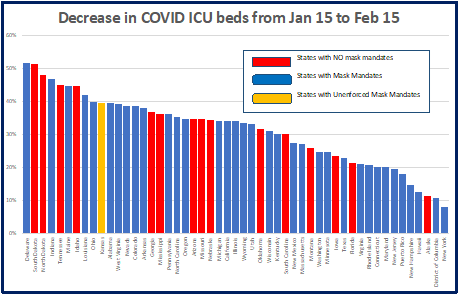
There does not seem to be any correlation between those states that have mask mandates and those that do not when looking at the decrease in hospitalizations. Looking at the data in another way, it is consistent that the change in hospitalizations in all states remained the same based on the activities of the citizens there, not because they wore or did not wear masks.
IF NOT MASKS AND IF NOT VACCINES, WHAT COULD ACCOUNT FOR THE DECREASE?
The only thing that seems to correlate with the dramatic decrease in hospitalizations in this specific period, is that it occurs 4-6 weeks after the “super-spreader holidays” of Thanksgiving, Xmas and New Year’s, combined with college intersessions all of which increased interstate travel, group assemblies and family gatherings.
If this is indeed the explanation for the decreases we are seeing, we can expect that over the next few weeks we will begin to see a new plateau as we get past the post-travel period and regain a stasis of transmission. This number would then begin to decrease as vaccinations become more prevalent in the overall population.
One of the factors seldom discussed, if at all, is the "vulnerable population".
With every disease there will always be a segment of the population that simply is never infected even when exposed to the virus. This could be due to coincidental circulating immunity generated by some previous exposure to something else, a difference in the target receptors on those people which do not provide a good target for the Spike protein, some variation in their HLA proteins that either associate with or don't associate with the receptor target, some difference in the cellular enzymes that restrict replication, or other factor.
The net result of which is to leave some percentage of the population "uninfectable". If this population is large enough, then the levels of herd immunity necessary will be significantly reduced.