Earlier this month I laid out what I believed were the pieces of the puzzle that implied that the US was going to attack Venezuela. I challenged those who support Mr. Trump to decide then and there whether they would support such an action. Most said I was wrong, that there would be no action inside Venezuela and that I was overreacting; that this was a drug war only.
Actions have now occurred. We can debate whether the incursion into Caracas by hundreds of soldiers, hundreds of helicopters, fighter planes, and bombers, accompanied by actions to shut down the power to the city, and, at least according to Mr. Trump, shutting down the power to the entire country, was an invasion or not. However, in Mr. Trump’s own words, the US now “runs” Venezuela, and will for the foreseeable future. He has also said that if the current Venezuelan Vice President does not do what Mr. Trump wants her to do, her fate will be “worse than that of Mr. Maduro”. He has also told us that the Venezuelan oil is now ours and will not be returned to Venezuela. By any measure, at least from the US administration’s standpoint, this was a military victory and a takeover of Venezuela. That, for me, constitutes an invasion. Whether or not we have boots on the ground today, or intend to have them there in the future, our insistence that the new government must do what Mr. Trump tells them to do is a de facto takeover. A bloodless coup perhaps, but a takeover, nonetheless, backed up by a military presence offshore.
The successful operation removed President Maduro and brought him back to the US to stand trial in a criminal court for crimes for which US warrants had been issued, not as a prisoner of war. This in itself is an interesting political theory. If the DOJ issues an arrest warrant for anyone in a foreign country, whether a citizen or politician, does that justify the forcible extraction of that person by the US military? Are there any limits to what we might be entitled to do, or what other countries might be entitled to do in our country based on indictments issued in their country?
Mr. Trump has also said that Venezuela has agreed to give the US 50 million barrels of processed oil which the US will sell on the open market, and that he, himself would personally control the proceeds from the funds generated (around $1.5 billion). Not the US Treasury, the US Congress, or any other administrative body – just Mr. Trump himself.
He also said that prior to the actions last week and directly after those actions, he had informed the large American oil companies of the actions planned so that they could be prepared, even though he did not inform any elected officials from either the GOP or the Democratic Party during those times.
Now what happens?
There are 30 million people in Venezuela living in an area about 10% the size of the US.
The political structure is still dominated by Maduro supporters. Removing Maduro does not remove his movement much as the next administration in 2028, without Mr. Trump, will not remove MAGA or his supporters from the US government.
Below is a map of the oil reserves and oil infrastructure in Venezuela. These oil fields are in the middle of the country, not off the coast or in a remote area. Pipelines must run to a group of ports on the ocean to load tankers. Refineries are scattered in multiple locations.
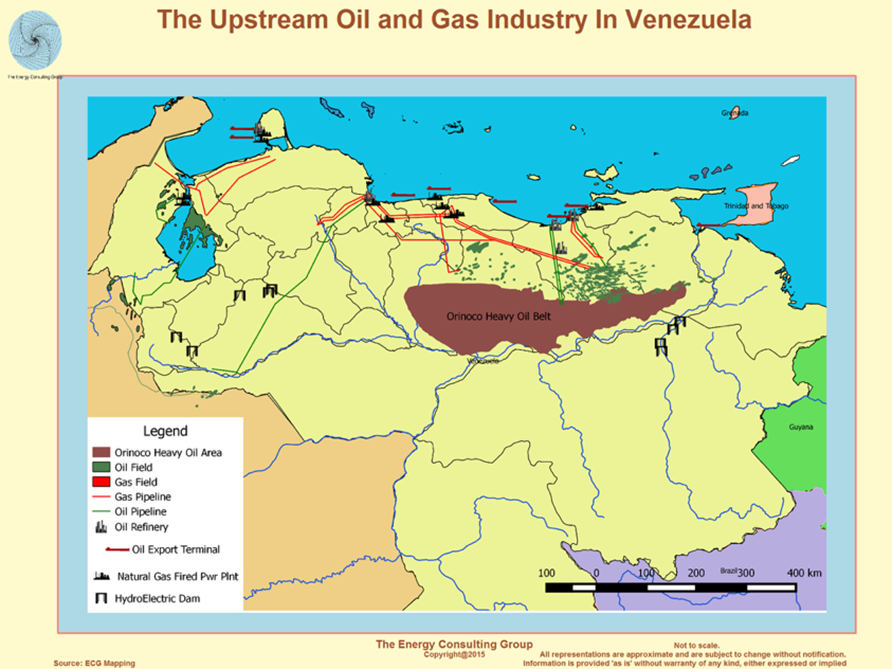
Do you think it is possible, conceivable, that there are a lot of people in that country who are not pleased with the fact that the US now “runs” their country? Or that the US is going to bring in US companies to take over their oil industry? Or that they will have no vote in how their country and its resources are administered for the next several years?
Perhaps some Venezuelans are convinced that the US is doing this for the benefit of the Venezuelan people. But, certainly, some are not so convinced. How have we won the hearts and minds of the Venezuelan people?
THE BASIC ECONOMICS OF OIL IN VENEZUELA
Oil is currently selling at about $57 per barrel.
I have used INCORRYS, an industry expert group to give us a sense of the economics of oil extraction in Venezuela. Here is a summary:
Venezuela produces “heavy” oil which requires special processes for production, transportation, and refining. It is most comparable to Canadian oil-sands bitumen, which you may recall from the debates about the Keystone Pipeline, are not easily processed in the US, but are primarily exported. So, any extraction in Venezuela will most likely require the construction of appropriate refining facilities that can be used prior to distribution.
Extraction often requires steam injection to reduce the viscosity of this heavy oil, and diluents are used during transport, both adding additional costs to the extraction.
Several factors are used when calculating the “Full-Cycle” cost of extracting a barrel of oil. These include the return of Capital, the difference between the oil price at the point of sale (the producing basin) and West Texas Intermediate, the WTI (Bloomberg calculates that Venezuela’s heavy crude should trade at roughly a $10 discount to the WTI), the operating costs in the field, royalties and/or production taxes, and G&A overhead. In 2020 the breakeven price of Orinoco region Venezuelan heavy oil was estimated to be about $50 per barrel. Inflation would then estimate those breakeven prices to be about $61 today.
Estimates place the costs of upgrading infrastructure to extract the oil at between $100-$200 billion over the next 10 years, with completion beginning no less than 5 years from now.
Based on current prices of $57 per barrel, extracting oil from Venezuela is currently unprofitable. If we look at the average price of a barrel of oil over the past 20 years, we see that there has been significant fluctuation, ranging from $40-$50 during demand slumps (like COVID), to over $110 in the early 2010’s. The average of 20 years has been around $70 when considering inflation-adjusted prices.
If we assume that prices will rise again to $70, then there would be an overall profit of $9 per barrel extracted and delivered to the port for shipment.
And at $9 profit per barrel that would mean that it would take sales of between 10 and 20 billion barrels of oil just to pay off the infrastructure investments (not including interest on the loans), let alone any profits for the companies.
And over a 10-year period that would mean that there would need to be between 1-2 billion barrels of oil sold per year. That would correlate to about 3-4 million barrels produced per day. Industry estimates suggest that with infrastructure improvements, the production of oil in Venezuela could increase from about 1 million bpd to about 2 million bpd, far less than what would be necessary to recoup the infrastructure costs over 10 years.
How much of the profit generated by American companies from the extraction, shipment and sale of the heavy Venezuela crude oil would be generated from these fields? Will the American companies who extract that oil and invest in the infrastructure be entitled to use those profits to recoup their investment, or at least pay off the loans used to pay for those improvements? How much “net profit” will remain after the accountants and lawyers for those companies calculate their own numbers? Will those companies then pay taxes on those profits to the US government?
Will there be anything left to share with the people of Venezuela?
If there is money generated for Venezuela, how will it go to benefit the people? Do we expect to issue dividends to the 30 million citizens? Will we, alone decide where and how that money is spent in Venezuela? Will it be used to fund new infrastructure projects for the Venezuelan people? Will those “improvements” benefit all of the people, or provide better roads for the wealthy, resorts for international travelers, or US-owned power plants and factories? Trickle-down economics has not worked very well in the US, I doubt it will work well in Venezuela.
RISKS FOR THE OIL COMPANIES
What are the risks for the US Oil companies that choose to invest? The Venezuelan military still supports the Maduro regime, the police are still just as corrupt as before, and the courts and public institutions are still packed with Maduro supporters. If you were an executive in a US Oil company considering investing time, money, and people in developing the petroleum industry in Venezuela, how would you factor in the risks that “freedom fighters” in the Venezuela (your own side calls them “freedom fighters”, the other side calls them “terrorists”) might sabotage your efforts and place your people in danger?
In order to modulate the risks, the US government may need to provide the hundreds of billions of dollars from the US taxpayers necessary to fit out the infrastructure so that oil can be extracted, and the US military may also be needed to provide security for those resources, both adding significantly to the US deficit and National Debt.
AND SO…
None of this will occur in the next year, or five years. And by then there will be new governments in the US and in Venezuela. Will there be treaties, passed by the Senate and signed by the leaders of the two countries to memorialize these positions in the next few months? Or will there only be one-sided decrees from the US that can be voided by either side at any time?
Too often, governments make short-term tactical decisions without good plans for long-term strategic results. I fear, and you may also, that we are facing the same in Venezuela today.