You may remember from High School, that the air we breathe has Oxygen and Carbon Dioxide (a molecule containing one Carbon atom and two Oxygen atoms), but that the main component of air is Nitrogen. 78% of air is Nitrogen, 20% is Oxygen, and about 0.05% is Carbon Dioxide. (just FYI, interestingly, there is over 20 times as much Argon in the air as Carbon Dioxide.)
You probably also remember that we breathe Oxygen to survive.
Animals - and we are animals - use the Oxygen we breathe to break down the sugars we eat, producing the energy we need to live. The process generates heat and produces Carbon Dioxide, that we exhale back into the atmosphere.
Plants do the opposite. They take the Carbon Dioxide in the air and use sunlight and water to take the Carbon out of the Carbon Dioxide, create energy and use the Carbon to build the molecules needed to live. This process generates excess Oxygen which is then released back into the atmosphere.
In both cases, the process is used to manufacture the molecules that are used to build the structures of the organism; and both plants and animals use basically the same molecules, things like proteins, sugars, DNA, and RNA.
All of these molecules contain Carbon and Oxygen; but they also contain Hydrogen and Nitrogen. Hydrogen comes from the foods we eat, or from water. Nitrogen needs to be obtained from the foods also.
Now, we said earlier that Nitrogen is the main component of air, so why don’t we get the Nitrogen we need from the air? The answer is because the Nitrogen in the air is a gas, and the molecule of Nitrogen gas is two atoms of Nitrogen bound together VERY tightly. It takes tremendous amounts of energy to break the Nitrogen molecules in the air down to Nitrogen atoms that can be used to make proteins or other molecules needed by plants or animals. So far, evolution has not created mechanisms in plants or animals to do this. Maybe sometime in the future new species will arise that can, but none exist today. There are some bacteria that can do it through a process called Nitrogen Fixation, in which they take the Nitrogen gas and break it down into Ammonia (one atom of Nitrogen and 4 atoms of Hydrogen).
WHY ALL THIS BACKGROUND SHIT?
I know that was a lot of wonky stuff. So, how is it useful?
Animals need Nitrogen to make all of the molecules that make up our bodies. Animals get that nitrogen from the foods we eat. We use Oxygen to make energy, and the foods we eat to get the elements we need to make proteins, DNA, RNA, hormones, antibodies, etc.
Plants need to get their Nitrogen from the soil. They get their energy from sunlight and Carbon Dioxide to make the same things animals make along with the structures that comprise the stems, leaves, branches, fruits, flowers, etc. that animals eat.
The issue for plants is that there is not an abundance of Nitrogen in the soil, particularly when those plants are amassed into things like farms. Without enough Nitrogen, the plants simply cannot grow.
Nitrogen-fixing bacteria in the soil can produce some of the Nitrogen, but not nearly enough for efficient farming, so worldwide agriculture needs to add Nitrogen to the soil. And growers do this by “fertilization”, a process in which “fertilizer” is used to make the soil more “fertile”. Fertilizer is primarily Nitrogen, added to the soil to provide the building blocks that plants need to grow.
WHAT IS FERILIZER?
A fertilizer has a number of ingredients, but for our discussion today we are focusing on the main ingredient, Nitrogen.
The way to deliver Nitrogen to plants is to give them a form of Nitrogen that can be “ingested” and used by the plants. The higher the concentration of Nitrogen, the more efficient the fertilizer. As we said before, Nitrogen gas cannot be used because the Nitrogen molecules in gas cannot be broken apart into atoms. One option is to use Ammonia (one atom of Nitrogen and 4 atoms of Hydrogen). But Ammonia is difficult to transport, dangerous to use, and requires injecting it into the soil under pressure, which is also difficult and expensive.
A far better alternative is Urea. Urea is a molecule with two Nitrogen atoms, 4 hydrogen atoms, one Carbon atom and one Oxygen Atom. It is far easier to handle, far easier to transport, safer to apply, and is a stable powder that can easily dissolve into water, making it readily available to plants for use.
Great! Let’s use urea to fertilize our crops!
Now, where do we get it?
Can we mine it?
No.
Urea does not exist in natural repositories. It is an organic molecule that must be made using chemical processes.
Almost all urea is made from natural gas. There are well-developed processes that take the methane (one carbon atom and 4 hydrogen atoms) from natural gas, mixed with steam (water) and the Nitrogen in the air to make ammonia, and then that is mixed with Carbon Dioxide, made from burning more natural gas, under high pressure which becomes urea and water. Drying that material (removing the water) produces granules of pure, solidified urea. This is stable and can easily be put into seaborne tankers and delivered to farms across the world.
Who can make urea?
Anywhere that there is natural gas, production facilities can be set up to make urea. However, in countries in which there is a need for energy, and in which there are distribution pipelines to deliver the natural gas to useful locations, the natural gas is primarily used to create electricity or other energy forms like heat (think of glass manufacturing, steel plants, paper plants, and food processing plants).
If the natural gas is not used locally, or in the distribution network for energy generation or manufacturing needs, then it needs to be discarded. In locations in which there is an excess amount of oil extracted from the ground, more than can be used locally, that oil is generally exported to foreign markets. And whenever oil is extracted, natural gas comes along with the oil (much like gas is expelled every time you move your bowels to remove the solid waste from your body).
That natural gas is an unnecessary byproduct of oil production. Today, some of that natural gas can be “liquified” by cooling it down to almost 300 degrees below zero. That liquified natural gas (LNG) is exported to facilities that can handle it and redistribute it.
Often the extraction wells for oil do not generate sufficient natural gas to support any processing plants, so, the excess natural gas is burned in chimneys near the oil fields in a process referred to a “flaring”. I am sure you have seen photos of these flared natural gas towers.
But you can also use the natural gas to produce urea, a product that adds economic value to your oil fields. And that is what has been done in the Persian Gulf. The tremendous amounts of natural gas produced during oil extraction provides a cheap source of material for making urea.
Today, almost 50% of the world’s urea is produced from the oil fields in the Persian Gulf, and the vast majority of it passes on ships through the Straits of Hormuz.
THE IRAN WAR AND THE PRICE FOR UREA
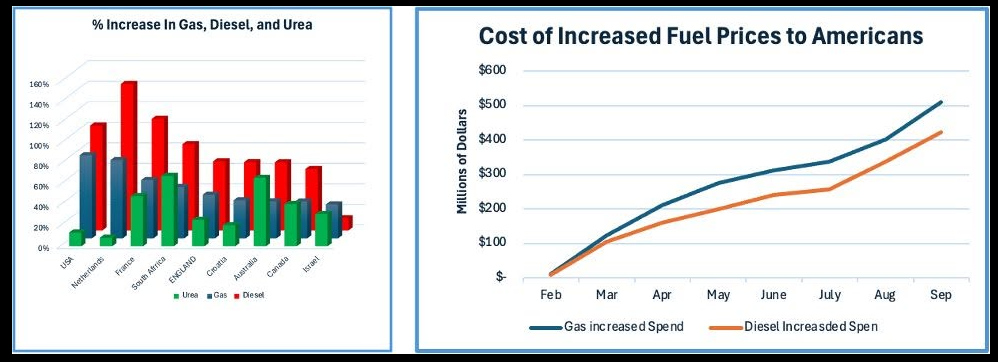
Not surprisingly, the price of urea has been dramatically affected by the war in Iran.
On January 20, 2025, urea sold for around
$391 a ton.
On January 20, 2026, urea sold for around
$402 per ton (most of which was exempts from other tariffs).
In March, after the Supreme Court ruled against tariffs, and after Mr. Trump imposed a 15% tariff on all products around the world urea increased to
$530 per ton, plus a 15% tariff, or around
A net of $610 per ton.
And today, after the beginning of the Iran war, urea prices have increased to over
$600 per ton, along with a 15% tariff, meaning a price of almost
A net of $700 a ton.
This is an increase in the cost of urea, in just three months of almost $300 per ton, or 75%.
One of the other byproducts of the current war in Iran and the restriction of vessel access to the Straits of Hormuz, is that filled tankers can’t leave, and empty tankers can’t come in. Without those tankers moving oil out of the Gulf and empty tankers taking on produced oil, the production facilities, whose storage capacities are full, need to cut back on their production, and with less extraction of oil comes less production of natural gas and less production of urea.
When production facilities are shut down, reopening them is not as simple as flipping a switch and starting the equipment up. It can take days or weeks to restart complex manufacturing operations.
Not only does this reduce the amount of urea being produced for export, but it increases the time that it will take to get back up to speed for production.
THE EFFECT ON AGRICULTURE IN THE US
The Southern US planting season runs from March-May, and the Northern planting season from April-June. The increased costs of fertilizer caused by the price increases due to tariffs and production limitations. And the decreased availability of urea decreases productivity and increases price pressures on farmers.
Fertilizer typically amounts to around 40% of the operating costs for crops, and accounts for about 7% of total farm costs.
The current conflict in the Mideast is having economic effects in this country. We understand that we are going to see increases in the price of gasoline at the pumps, but we will concurrently see increases in the cost of food because of the decrease in availability of fertilizer and the increase in those prices across the country.