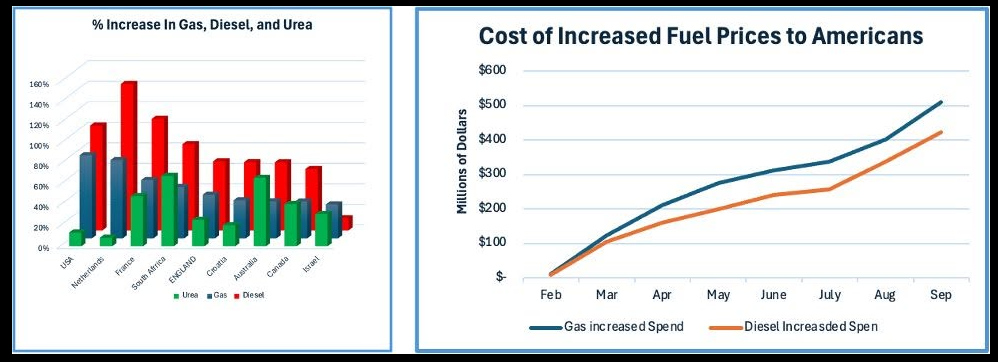
| IMPORTANT NOTE: This essay IS NOT about supporting Iran. My analysis of the results of the conflict is totally independent of any consideration of the validity of the military action. The costs of the conflict to the U.S. are important to understand. Those costs not only include the expenditures of our military, but the concurrent expenses to the U.S. and the world economies. |
I have written before that although the Iran War is restricting access to Persian Gulf oil and raising gas prices, and that this is painful, it is transitory. There will be a lag in the reestablishment of oil flows, a lag of months to account for the reopening of the Strait of Hormuz, the resumption of oil field production, and the time necessary for tankers to transit the ocean and reach their destination ports and refineries. We can expect gas prices to rise over the next few months, and to remain high until the market restabilizes.
I remain far more concerned about fertilizer.
Modern agriculture requires the addition of nitrogen and other nutrients to the soil exactly at specific times in the planting cycle. While the seeds germinate and grow into the plants we use for food, they need those nutrients delivered through fertilizer. Without it, they simply cannot make the proteins, chlorophyll, and DNA that they need.
Farmers who do not have access to fertilizer must switch to crops that do not need fertilizer or cut back on what they plant. Either way, food production and feed for livestock is reduced.
Reduced production of corn not only reduces your access to corn on the cob but reduces the availability of sugar syrup made from corn, ethanol made from corn, and beef raised on corn.
The same is true for soybeans. This not only reduces the availability of tofu and edamame, but it directly diminishes the protein used to feed poultry, pigs, cattle, and fish. Soybeans are also used in industrial applications such as lubricants, adhesives, and foam insulation.
Corn, wheat, and rice supply more than half of the dietary calories that the world needs to feed people, and all of these crops require fertilizer at specific times in their planting cycles.
THE MATH OF THE TRANSIT VESSELS
Between March 4 and April 20, 187 vessels successfully transited the Strait of Hormuz. That represents a passage rate of less than 4 per day. And that includes the 53 vessels that passed through the strait on April 18 alone, when Iran “opened” the Strait and before the U.S. executed its own blockade, triggering Iran to reimpose its blockade. Subtracting that single day, a total of 134 vessels have passed through the strait since March 4, or a little over 2 per day. Compare that to a rate of 160 per day for the 2 months preceding March, and about 135 per day during 2025. This represents a drop of close to 10,000 vessels transiting the Persian Gulf since the Iran War began.
Of the 187 vessels that did pass through, 38 were Chinese, 30 were Greek, 23 were from the UAE, and 23 were from Iran. Those 4 countries account for over 60% of the total vessels.
Of those 10,000 vessels, about 1,300 carry fertilizer. Each of these ships carries about 70,000 tons of fertilizer. So, the reduction over the past 2 months has resulted in the loss of over 90 million tons of fertilizer.
UREA AND AMMONIA PRODUCTION RESTRICTIONS
We have talked about the Urea that comes from the Gulf States (Iran is the single largest exporter of urea among all the Gulf States); but even other countries like India, Pakistan, and Bangladesh, which have their own urea production facilities, require the natural gas they import from the Gulf States as the feedstock for producing urea in their manufacturing facilities. Without that natural gas, they cannot produce urea for their own use.
The main alternative to Urea is Ammonia. It can be directly applied to crops, although this is more difficult, expensive and dangerous than applying urea. Ammonia is a liquid shipped in tankers.
Ammonia can also be used to produce urea in local production facilities, but the ammonia needs to be produced, bottled, containerized, shipped and delivered to those sites. 30% of the world’s ammonia comes from the Gulf States.
THE OTHER NUTRIENTS IN FERTILIZER
PHOSPHATE
But plants also need two other supplements, Phosphorous and Potassium.
Phosphorous is delivered as a salt called Phosphate and is essential for the energy produced in all living things through a chemical called ATP. It is also essential for the cell membranes of plants, their roots, the chemicals for photosynthesis, and the production of flowers and seeds.
China is the largest producer of phosphates, and China has blocked phosphate exports since the onset of the Iran War, reducing worldwide supplies by 25%.
26% of Diammonium phosphate (DAP), the most common form of spreadable phosphate fertilizer, comes from the Persian Gulf.
Phosphates can be produced here in the U.S. from phosphate rocks, but the process requires sulfuric acid. The Persian Gulf produces over 50% of the world’s sulfur which is the basic chemical used to make sulfuric acid.
So, the Iran War and the shutdown of the Strait of Hormuz (by Iran AND the U.S. military blockade) is disrupting urea production and distribution, ammonia production and distribution, phosphate production and distribution, and sulfur production and distribution.
POTASSIUM
Potassium is another chemical that is required for plant growth. It regulates the opening and closing of the pores in cell membranes, managing water loss. It also is important in photosynthesis and sugar usage.
Potassium comes primarily from Potash mines in Belarus and Russia, and U.S. sanctions on those countries have reduced the global supply of potassium.
THE RESULTS OF FERTILIZER SHORTAGES
What happens when fertilizer chemicals are no longer available to farmers?
Food stocks for humans are reduced.
And with reduced feed for cattle, farmers become forced to kill or sell off their livestock, increasing costs, but also reducing the herds that are necessary for food in the future.
According to the World Bank, over the past 2 months, fertilizer supplies worldwide have been reduced by between 30% and 50%. At the point in the year that farmers are preparing their fields for planting, there was insufficient fertilizer available. And when reapplication is generally done in mid-April to May, supplies will have become scarcer. Loan guarantees from the federal government may help farmers with the costs, but if there is simply not enough fertilizer to go around, money will not help.
But don’t we have enough urea made in the U.S. for our own use?
The Mosaic Company is a publicly traded corporation (NYSE: MOS) formed in 2004 through the merger of IMC Global and Cargill’s fertilizer business. It is based in Tampa, Fl, and serves over 40 countries. It provides over half of the U.S. supply of potash (potassium) and phosphates. Mosaic, CF Industries, Nutrien, and Koch supply the majority of urea to U.S. farmers, but they also sell products around the world. Shortages of fertilizer in other countries motivates these companies to raise their prices and divert supplies to overseas markets. Investors will chase the higher returns. Eventually this will result in shortages here in the U.S. also.
REDUCED PRODUCTION CAPACITY
Finally, the Iran War has disrupted the production facilities that make urea. Gulf urea production dropped almost 60% per week after the war began. Iranian attacks on Qatar and Bahrain have damaged the industrial infrastructure essential for urea production. The joint Iran/U.S. blockade of the Strait of Hormuz has stranded over 1 million tons of urea on vessels in the gulf, and packed all available storage space, forcing manufacturing shutdowns.
Restarting a urea production facility is not as simple as just flipping a switch. Once shut down, there are necessary steps to restarting. First, the upstream ammonia plant must be started, which generally takes between 1 and 2 weeks. Only then can the urea plant be restarted, which takes an additional 1-2 weeks. So, for an undamaged plant, restarting will take between 2 and 4 weeks.
For facilities that were damaged in the war, significant time is needed to rebuild and repair the facilities. That needs to be followed up with inspections and safety checks before the plant can be restarted. Typically, these restarts will take months, or years to complete.
So, unlike oil, which can begin to be shipped immediately after the Strait is reopened, urea, phosphates, and sulfur will take months or years to recover to the production levels existent in February this year.
At the same time, the Iran War has damaged more than 80 energy facilities in the Gulf (Rystad Energy report); more than a third have been severely damaged. The IEA said this week that the repairs to those facilities could take as long as two years, and cost at least $34 billion. This is further complicated by the limited availability of equipment to do those repairs, equipment which is stretched across the globe on other energy projects.
Iran’s South Pars gas fields were severely damaged by Israeli attacks on March 18, and that will constrict the ability of Iran to produce urea for several years. Repairs are estimated to cost almost $20 billion. Without those funds, the shutdown may last many more years.
Iran retaliated for the attack on its gas fields by attacking Qatar’s liquified natural gas facility, responsible for almost 20% of Qatar’s gas exports. This damage will cost over $20 billion to repair and is estimated to take as long as five years to complete.
Iran has also attacked pipelines, refineries, and production facilities in Saudi Arabia, Kuwait, and the UAE.
The U.S. may be able to withstand these shortages, but not the rest of the world. According to the U.N. World Food Program, more than 300 million people already do not have enough food, and it predicts that the Iran War will add an additional 45 million people to those rolls before the end of this year.
Wars have consequences.
While our military has demonstrated unparalleled abilities to control the battlefield, they have not been able to prevent corollary damage to the basic building blocks the world needs to feed itself.