NOT AS STRONG AS YOU THINK YOU ARE
Maybe you were in business, and you decided that you could raise your price because your product was market-dominant. Perhaps that strategy backfired; your customers felt alienated and decided to go to another supplier anyway, and you not only lost that sale, but you lost the customer for future sales. Getting those customers back is costly and puts them a stronger negotiating position than they were in originally.
Maybe you hired a new employee who almost immediately demanded a large raise because he felt that he was indispensable. Perhaps you said no, and the employee lost his job. Or the union demands were so high that you decided to shut down the business. Lose. Lose.
Maybe you had a romantic relationship that you pushed too far, too fast. You scared away the partner and lost the chance for a long-term connection.
These are all examples of “overplaying your hand”. Because you thought that your position was so strong, that the other party would cede to your demands.
This can be a risky strategy.
CHINA
We have long assumed that the US marketplace for Chinese goods is so large, and so important to China that the US can exert pressures to achieve its own economic and political aims. The current administration, with that assumption, has imposed huge tariffs on China with two goals in mind. First, it is to reduce imports to this country, stimulating domestic manufacturing and reducing trade deficits. Second, it is to force China to modify its strategies to better align with those of the US. And the constant rhetoric from the White House and the administration thought-leaders has been that China would “pay” those tariffs by absorbing the increased costs.
Has this worked? Or have we overplayed our hand?
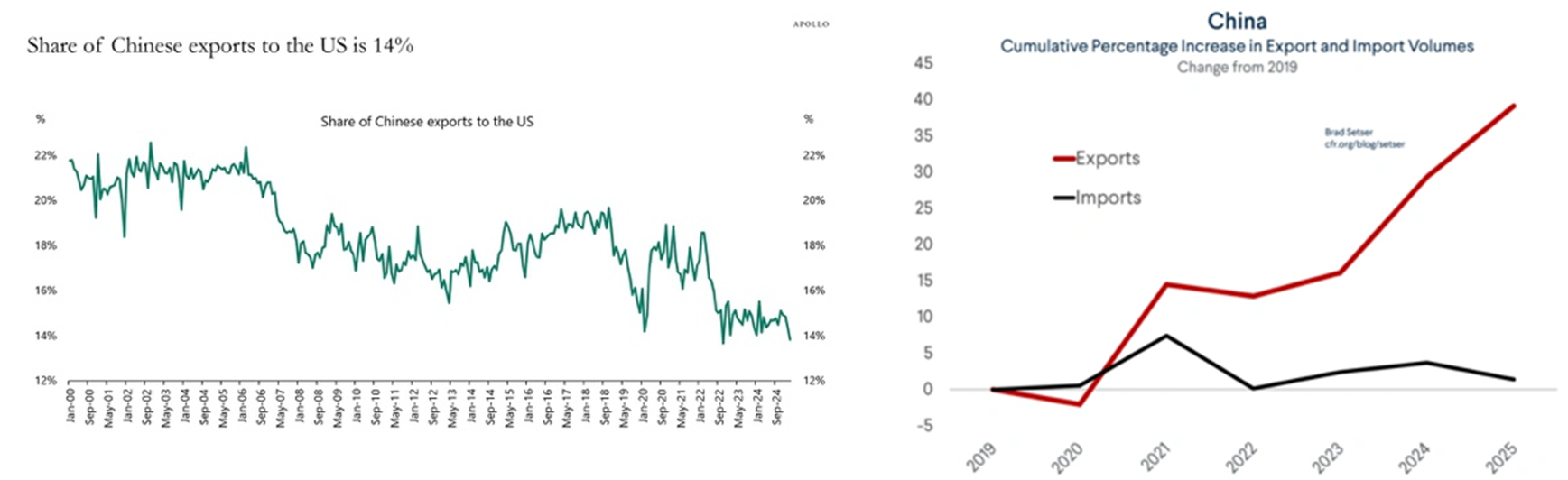
The charts here show two things.
First, the chart on the left measures China’s exports to the US as a percentage of their overall exports. At the beginning of this century, those exports amounted to around 22% of their overall exports, but today, even before the assessment of tariffs, that percentage has dropped by over a third, to 14%. 14% is still extremely significant, but the trend is downward.
The chart on the right measures the overall growth in worldwide exports for China.
Even with the decrease in exports from China to the US (as a percentage of overall exports), the Chinese economy is growing its exports. Now, to be fair, China has also redirected its manufacturing base from small, inexpensive items (now often off shored to other countries) to larger, more expensive items like tech products and automobiles. The Chinese electric vehicles are sector leaders around the world, but we have denied ourselves the opportunity to purchase them here.
Did China absorb the costs of tariffs?
No. The overall costs of imports from China have actually increased by 2-3% over the past year. Because of the relocation of consumer product production to other countries, China is less reliant on US purchases of those low-cost, low-profit items than before and, therefore less motivated to adjust the pricing of those items.
What does the future hold?
One plausible conclusion that can be drawn from these observations is that China, threatened by the US to lower its prices or risk losing the US market, has decided that the US has overplayed its hand, and that it would be better business for them to look to other markets for the sale of their goods. This has been successful, and even with a reduction in exports to the US, overall exports have increased and continue to do so. Accompanying that decision has also freed China from the requirement to import products from the US to reciprocate trade (see soybeans and Argentina). Over the next years we should expect this trend to continue, for once a supplier shifts its focus to other customers, it is difficult to get those supplies back, except on favorable terms to the supplier