A lot of talk lately has centered on who is to blame for the spread of COVID-19 in the US. Some on one side of the issue blame the administration for ignoring the threat, acting slowly, acting late or using the wrong tactics. Others, on the other side of the issue choose to blame China, the WHO, the media or other politicians.
You may choose whichever side suits you. My concern is how to learn from the event. To this end the comparison with South Korea is extremely interesting. Both countries recorded their first death related to the virus within 2 weeks of each other (with South Korea seeing the first death earlier than the US). Since then, the nature of the infection in each country has been dramatically different.
Why?
First, here are some of the numbers:
First confirmed death in South Korea from COVID-19 was January 20, 2020
First confirmed death in US from COVID-19 was February 5, 2020
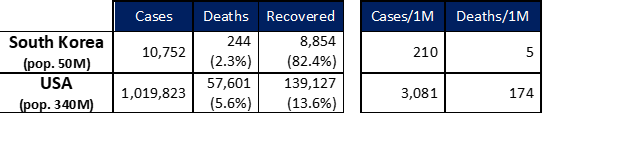
Here are the numbers since then (as of April 27, 2020):
Question? What did South Korea do right, and what did the US do wrong?
Both countries had access to the same information from China and the WHO.
Both countries have sophisticated healthcare systems.
Both countries use healthcare surveillance systems.
Both countries had the exact same tools, in the same quantities relative to their populations available to them: testing, ventilators, ICUs, etc.
The chief difference between the two countries is that S. Korea, having experienced directly the MERS epidemic, had prepared in advance for another outbreak. The US had abandoned its preparedness by eliminating those sections of the NIH, CDC, NSA and NIAID that were involved in tracking and preparing for potential outbreaks of new viruses with the potential to cause pandemics.
Within 2 weeks of the first reported death in S. Korea, the country mounted a trace, test and treat strategy, based on codified preparations utilizing the country’s advanced information technology system. This allowed them to trace individuals suspected to be infected or who had been in contact with an infected person. They were able to flatten the curve of newly confirmed cases and deaths by the middle of March.
By focusing so early on tracking and tracing, they were able to deploy their limited amounts of tests to those activities. They tested not only the severely ill, but the contacts to determine, as quickly as possible, where the infected individuals were.
What South Korea DID NOT DO, was any immigration control, lockdown or roadblocks.
On the other hand, the US did virtually NO track and trace of the original cases in Washington or NYC. Instead, the US pursued the sole strategy of controlling travel into the country. And that strategy was so diluted by exceptions and a focus on a tiny list of specific countries, that it only had a small, limited affect. Lockdowns were only instituted, and only in limited ways and locations, and only at the end of March, well beyond the point at which S. Korea had already flattened their curve.
Because the US did not track and trace immediately, the limited supply of tests were needed to be deployed not in looking for infections, but in protecting healthcare workers in hospitals. This diversion of tests only made the spread of contagion worse because those infected and not identified were often asymptomatic and out and about shedding virus into the environment.
The net result of waiting, imposing modest controls and restrictions resulted in infection rates in the US 15 times that of S. Korea and death rates a whopping 35 times as great.