When a poultry farm tests positive for bird flu, the clock starts.
Within the first 72 hours, farmers start depopulating, an industry term for killing contaminated flocks.
From foam to heatstroke: The business of bird flu depopulation
Bird flu containment isn’t just a public health challenge. It’s a system of mass killing. Below is a breakdown of the number of birds culled by each method used by the poultry industry and federal contractors since 2022.
Chart and data analysis by Lauren Cross and John McCracken, Investigate Midwest
Source: USDA depopulation records and Investigate Midwest analysis. "Birds killed" represents the number of animals culled by method per year during confirmed avian flu outbreaks.
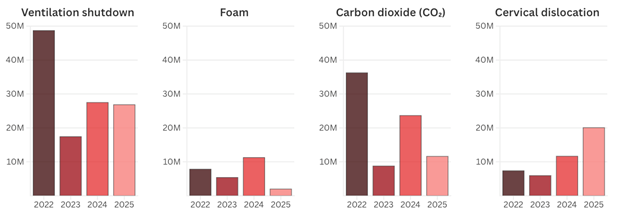
Note: 2025 data covers Jan. 1 to April 18. Other culling methods such as gunshot, blunt force trauma and injectables were rarely used and are not included in this graphic due to limited scale or incomplete data.
“The biggest factor in agricultural safety is the urgency,” said Bethany Alcauter, director of research and public health for the National Center for Farmworker Health, a Texas-based nonprofit that advocates for worker safety and health. “Everything has to get done in a short amount of time and that really can be problematic because there’s not the same amount of time to adequately train workers.”
A separate behavioral health official wrote that they witnessed workers with torn or missing PPE, PPE not being utilized, and saw “animal matter, including blood stains and feathers” on workers’ torn PPE.
Once a farm has depopulated its flock, the work isn’t over.
Carcasses, feed, eggs, manure, and other organic materials are gathered and composted or disposed of, a process that requires a fleet of equipment and workers.
Composting the bodies of birds infected with bird flu is a common practice in disposal and requires all organic material to reach an internal temperature of at least 130 degrees Fahrenheit for three days in order to kill the virus and other pathogens.
Contaminated feed, manure, bodies, eggs and other waste are stacked into large mounds, monitored for internal temperatures and eventually spread back onto land as fertilization.
The same behavioral health official noted that culling and disposal workers were required to shower at the entrance and exit of the barn, but workers said several people were not showering because the “water has a dead chicken smell” and “the horrible smell stays on the skin.”
Despite the sweltering heat inside the barns, hired workers wear gloves, face masks and other protective equipment and repetitively pick up flailing, sick chickens and place them into a metal container filled with carbon dioxide. In a few minutes, the chickens are dead.
In other cases, workers seal the barn doors and crank up the temperature, causing the birds to die from heat stroke, or flood the barn with a suffocating foam. In a few hours, most of the chickens are dead and workers begin to haul thousands, if not millions, of lifeless caracasses out to dump trucks.
The stench of death seeps into workers’ clothes, sweat and even the water they’re supposed to shower in.
Patriot Environmental Services is the nation’s only federal contractor able to provide depopulation services when requested by the USDA.
Over 168 million birds have been depopulated in the U.S. since early 2022, the majority of which have been at commercial operations. When a flock is killed, the USDA can compensate producers for the loss of revenue and the cost to depopulate.
Currently, operators are paid a flat fee for depopulation and disposal fees, regardless of whether the farm handles the killing on their own or hires a contractor. Producers are reimbursed $1.62 per bird for egg-laying chickens, $2.95 per meat chickens, $4.50 for turkeys and just over $5 per duck, as of February 2025, according to USDA documents.
--------------------------------------------------------------------------------------------
An update.
Although there is increased evidence of human disease from Bird Flu, there is nothing currently with which to be concerned. It does seem that these infections come from direct contact with infected chickens, turkeys, ducks and cattle.
The current risk of infection for the general public is low.
I do believe that the increased spread of the disease in livestock, both commercial and private, will eventually result in the generation of a viral strain that will infect humans and spread human-human, but the time frame is not possible to predict.
I do want to remind everyone about what “the Flu” is and what it is not.
When you meet someone who says that they were laid up yesterday with “the Flu”, but feel much better today, they DID NOT have influenza.
There are a wide range of viruses, whose infections cause similar symptoms: cough, scratchy throat, chills, fever, aches, runny nose, etc. The bulk of these infections are rather benign, causing infections that last a few days and that are well treated with fever reducers, cough medicine and other medications for sneezing, running nose, congestion, etc.
Most of the time these infections begin with, perhaps a scratchy throat in the evening or morning, which becomes a cough hours later, followed by fever, sneezing and other symptoms, so that within about 24 hours you feel sick.
THIS IS NOT THE FLU.
Influenza comes upon you very quickly, from feeling fine to feeling quite ill in a matter of hours.
And when you are infected with Influenza, you can become VERY ill.
A physician once described “the Flu”, as feeling like you are going to die, but afraid that you won’t.
This is a serious illness that can result in your becoming bedridden for a week or more, and recovery can take from weeks to months.
Remember, please, that in the 1918 Spanish Flu outbreak, young people got sick in the morning and were dead by that night.
Vaccines will become available. Please take them ASAP.
We can hope that the current Administration takes this extremely seriously and moves to quickly contain the outbreak when it does occur.