COULD TARIFFS REPLACE THE INCOME TAX?
In 1913 the 16th Amendment to the Constitution was passed, allowing for Congress to establish an income tax. Immediately, a bill was passed and enacted with a Progressive Tax, leveling higher rates on those who could better afford to pay those taxes. For over one hundred years the American tax system has refined the Progressive nature of income taxes.
Recently, Mr. Trump and Sec. Bessent have suggested that Tariff revenue could eventually replace income taxes.
What would be the opposite of a Progressive Tax?
The opposite would be a tax that affected people with less income more than those with more income.
This is the effect of tariffs. Tariff revenue, collected by the government is eventually passed on to the consumer through higher prices. Therefore, the higher the percent of a household income that is used for the purchase of goods, the higher the effective rate of taxation on that household.
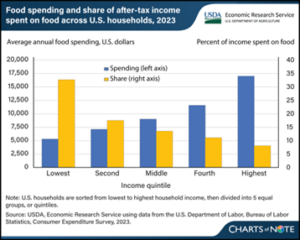
The attached chart looks at that issue. It compares the amount of spending on food related to the income of the household. Not surprisingly, the higher the income of the household, the more actual dollars are spent on food. But perhaps a little more surprising is that when that spend is presented as a percentage of the household income, you can see that the lower the household income, the higher the percentage of money is spent on food.
Since food is affected by tariffs, those in lower income households will be paying a larger share of their overall income in taxes than those in higher income households.
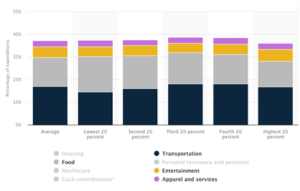
Spending as a Percentage of Income (2024 Data)
The "wealthy" (the highest 20% of earners) spend roughly half of their pre-tax income, whereas the lowest earners often spend more than they officially earn in a year:
- Highest Income Quintile: Average pre-tax income is significantly higher than their average annual expenditures of $150,342.
- Lowest Income Quintile: Average annual expenditures are $35,046. For many in this group, spending actually exceeds 100% of their reported pre-tax income due to the use of savings, credit, or government assistance.
- Middle Income Quintile: Generally spends a much larger share of their income (often 75-85%) than the wealthy, leaving far less for savings.
Where the Money Goes
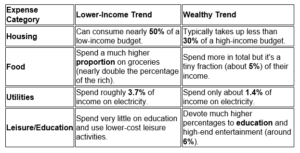
Lower-income households are "forced" to spend most of their income on necessities, while the wealthy have more "disposable" income for investments and luxury items.
And if you wanted to replace the income tax with tariff revenue, how would you do that.
Well, last year the US Treasury collected about $2.4 Trillion in income taxes.
Also, last year, the US imported about $3.3 Trillion of goods.
In order for the US Government to collect the same amount of money from tariffs as it does from income taxes, the tariff rate would have to average 73%, and with tariffs that high it is highly unlikely that an equal amount of goods would actually be imported. The less imported, the less tariffs collected. And with less goods imported, replacing income taxes would require even higher tariff rates. It is a classic vicious cycle.