I have been thinking about the issue of deportation. It seems to me that the headline is superficial and fails to look at the logistics of the issue. I hope to layout those matters in more detail here.
First, some facts about the Illegal Immigrant community in this country.
How many illegal immigrants are there currently in this country?
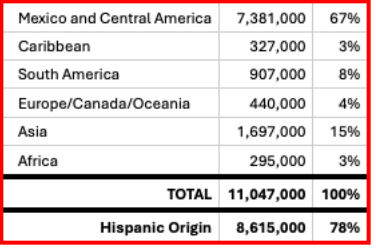
How many illegal immigrants are currently in Federal and State Prisons?
About 63,000, or about one-half of 1 percent (0.5%).
Some other statistics:
- About 4% of all illegal immigrants currently get unemployment benefits (440,000)
- 33% live with at least one US-Citizen child
- 62% have lived in the US for a minimum of 10 years
- 54% are male, 46% are female
- For those 25 years old or older, 54% have received at least a high school degree
- 28% own their own homes
Illegal immigrants, employed across the spectrum but with an emphasis on manufacturing, agriculture, construction and food service, come from a variety of countries. Some cross the borders, both north and south, without visas, some arrive through those borders as well as by air and sea with tourist visas, or educational visas, and stay past their due dates. They remain in this country as “illegals”.
Over one quarter of these illegals are NOT Hispanic.
Most have been here at least 10 years, have families, often with native born US citizen children, are educated and employed, paying taxes. A large fraction owns their own homes.
With that background we can look at the logistics of deporting those illegals.
What are the legal requirements for deportation?
Persons subject to deportation may have the right for a hearing before a judge, but expedited deportation can be instituted for people who have traveled here without travel documents, or expired visas. It may be that the US government may be able to expedite deportation for the majority of illegal immigrants, without judicial hearings.
What about personal property?
Personal assets remain the property of the deportee who may have access to those items, sell them, or designate a third party to manage them. They are NOT confiscated or sold by the Government for expense reimbursement.
How would the US Government seize illegal immigrants?
Immigration and Customs Enforcement (ICE) has the right to arrest and detain identified illegal immigrants. ICE has about 8,000 agents assigned to this task. If each pair of agents was able to arrest and detain 2 people a day (sometimes they can get dozens at a factory, sometimes it takes weeks to find someone), they could potentially arrest 8,000 people per day. It would take almost 6 months to arrest and detain each 1,000,000 people.
Using the National Guard or the US Army could accelerate arrests, but that would need to survive legal challenges.
Would there be compensation or criminality for those companies from which illegals are arrested? Would those companies then need to shut down activities or increase prices?
Where would the US Government detain several million people?
ICE has about 41,000 detention beds available.
There are currently about 1.3 million people housed in Federal and State prisons across the US, and they are at 103% capacity today.
Therefore, there is no room currently to house a million detainees.
It is estimated that you would need at least 20,000 acres to house 1,000,000 people. Those locations would also need, food distribution, water distribution, sewers, storm drains, medical care, security, internal transportation, phone and internet service (at least for emergencies), fire departments, and other necessary infrastructure. Where would you get the land to construct these detention centers? Who would pay for the land? Would you use national parks or Federal lands? Is that legal?
Where would you deport several million people to?
Each sovereign country controls access to their own airports, seaports, train terminals and highways. There is no international law that allows one country to dump hundreds of thousands of people across the border of another sovereign state. Particularly if, as the incoming US administration has stated over and again, that the deportees are murderers, rapists, drug dealers and criminals, what country would ever accept those people back into their country?
If you cannot deport hundreds of thousands or millions of detainees, the centralized “cities” become even more complicated. You would need schools, some sort of employment to keep people busy, courts to settle disputes, entertainment, etc., or else there would be justifiable rioting.