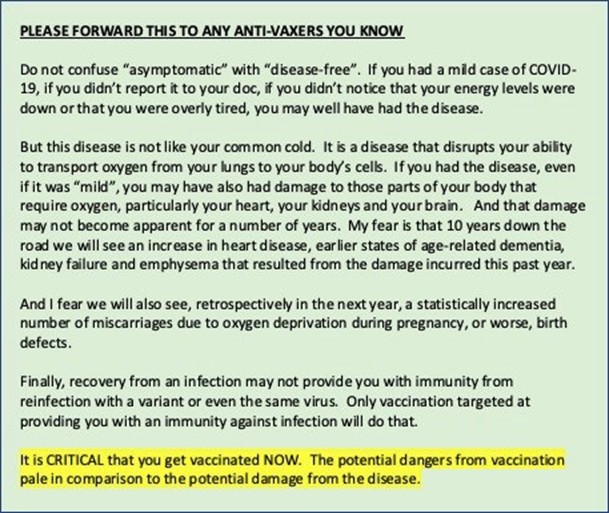
I have written in the past, in regard to the issue of Pregnant women getting vaccinated, about the risk/benefit value of vaccination over potential infection. I have argued that any potential risk associated with vaccination is tiny compared to the risks of infection, and I have suggested that we may see a statistically significant increase in miscarriages in the upcoming year compared to historical rates.
Washington University in St. Louis has just published an article in Nature that speaks to this risk/benefit analysis. I believe it is extremely important and worth noting.
The researchers looked at almost 90,000 patients that had diagnosed COVID-19 infection, mild enough so that they did not need to be hospitalized and compared that group to almost 5 million control patients who were not infected.
As I have discussed before, COVID-19 is NOT a respiratory disease like influenza, adenovirus or the common cold. Rather it is a “respiratory entry” virus. In other words, the virus enters your body through your lungs, but the disease is more complicated. COVID-19 affects the ability of your lungs to transport oxygen to the blood, and also affects the ability of your red blood cells to transport that oxygen to your cells. Without oxygen those cells can become damaged, so any cells that are actively using oxygen can be affected.
- The heart, beating constantly, needs a constant supply of oxygen for the muscle to work well. Starving the heart of oxygen can result in long term damage.
- The brain also requires constant oxygen, and starving the brain of oxygen can result in permanent brain damage.
- Dividing cells like hair follicles can be damaged.
- Developing fetuses can be compromised.
In this new study, the researchers calculated the scale of some of these effects including breathing problems, irregular heart rhythms, mental health issues and hair loss.
The findings were dramatic.
Mild COVID-19 survivors had an almost 60% increased risk of death over the following 6 months than the general population, and almost 30% as great as those patients who were hospitalized with severe disease and survived at least 30 days.
- Recovery from mild COVID-19 infection resulted in increased likelihood of:
Shortness of breath - Stroke
- Headaches
- Memory problems
- Anxiety
- Depression
- Sleep disorders
- New onset Diabetes
- Coronary Disease
- Heart Failure
- Palpitations
- Irregular heart rhythms
- Constipation
- Diarrhea
- Acid reflux
- Blood clots
- Hair loss
- Joint pain
- Fatigue
- Anemia
The take-home message from this study is that COVID-19 is not a disease that you recover from quickly and easily. There are scars left in multiple organs in your body that will cause additional problems later in life.
The fact that we see these adverse events within only 6 months after infection is just a harbinger of what we can expect to see over the next decade. There will be an increased amount of heart disease, earlier and more severe that would have normally been expected, the same for early-stage brain diseases, lung diseases and joint disease.
The only way to avoid these risks is to get vaccinated. Whatever small risks may be found short-term or long-term from the vaccines is dwarfed by the health risks of becoming infected, EVEN IF THE INFECTION IS MILD.