EMERGING VACCINE ARITHMETIC
The first shipments of mRNA vaccines have been shipped. This landmark event should rightfully be celebrated. Not only is this a landmark event in the battle against COVID-19, but it is a landmark event in medical history as this method for vaccine production will absolutely revolutionize the approach to vaccines for multiple other diseases including cancer.
I do not see any significant downstream health issues with these vaccines and will be first in line for an injection as soon as I become qualified to receive it. I encourage everyone to be vaccinated including those of you who may have tested positive for the virus in the past and recovered.
Whichever vaccine becomes available to you, please take it. There is little or no difference at this point between those that will be available.
And now…my concerns.
We have certainly become inured to the daily death totals. We now have almost 320,000 documented deaths from this disease, and that number will most certainly be revised upward in the years ahead as the epidemiologists review the actual death statistics and are able to determine those additional people who died at home or untested in hospital settings.
Current death rates are running a little over 3,000 deaths per day and we have just begun the period that will measure the “Thanksgiving spike”. Remember that deaths occur at least 4 weeks after infection, so the surge that occurred on November 26-29 will not show up in the death rates until around Christmas, and that “Xmas spike” won’t be seen until late January.
We are all excited about the beginnings of the appearance of vaccines and the initial well-publicized immunizations. This is surely the beginning of the end of the pandemic. These “miraculous overnight achievements” have been in the making since at least 2003 when work began on developing a vaccine for SARS-1.
BUT…the vaccination that has begun needs to be understood as what it is and not what we hope it will be. The virus is not going to be eliminated tomorrow, or next week or next month. Here is the math and what we can expect in 2021.
HOW MANY IMMUNIZATIONS DO WE NEED PER WEEK?
We are seeing a shipping rate of two million doses per week for the foreseeable future from Pfizer and we can expect something similar from Moderna. These are for the two-dose vaccines that will be used from Pfizer/BioNTech and Moderna. So, if in week 1, 2 and 3 there are a total of 4 million doses shipped from the two manufactures and used each week, then in weeks 4, 5 and 6, all of the available doses will be used for booster shots. Therefore, over the first 6 weeks a total of 12 million people will be vaccinated, or 2 million per week.
How many vaccinations would we need to make per week in order to vaccinate enough people over the next year to reach “herd immunity”?
Assume a 90% effectivity rate for the vaccines, and a projected need to get 70% of the population immunized to reach herd immunity. The current population of the US is approximately 330 million people. To reach 70% with a 90% efficiency rate, we would need to vaccinate 256 million people. And if we wanted to reach those 256 million people within 50 weeks starting January 1, we would need to vaccinate 256/50 or about 5 million people per week.
All of that is possible assuming that there are no glitches in the production rates for these vaccines. Additionally, J&J expects to be able to apply for EUA from the FDA for their vaccine at the end of January. It looks, unfortunately like the AZ vaccine may be delayed because of multiple issues during their Phase 3 trials, so that vaccine may not be available until later in the spring. Vaccines from Novavax, Merck, Glaxo/Smith Kline and others will also be coming online later in the year.
Parenthetically, the reason that BioNTech, Moderna, AZ and J&J are so far ahead of the others is that they use brand new technologies that are based on the genetic sequences of the viral genome rather than disrupted virus particles or attenuated viruses. The publication of the full genetic sequence of the COVID-19 virus by China, 12 days after the first identified case in Wuhan, provided these companies a clear roadmap on what to make, and the work done over the previous 17 years to be able to “read” that roadmap and know where the sequence for the spike protein was, gave them a tremendous head start.
WHAT WILL DEATHS LOOK LIKE IN 2021
Unfortunately, immunizing small segments of the population will not eliminate deaths right away.
I have done some modeling of 2021 (anyone who would like to see the spreadsheet can get it upon request).
Here are my assumptions:
- In order to get “herd immunity”, 256 million people will need to develop immunity.
- We can assume that approximately 25 million people who have already recovered from, or experienced mild disease are already immune. So, the real number to achieve will be closer to 225 million immunized individuals.
- We can assume that manufacturing capacity will continue to increase per month. I have used a figure of 5% per month because that yields an approximation of 1 billion doses of vaccine in the calendar year of 2021 for Pfizer and Moderna, which is what they have projected.
- I have assumed that the J&J vaccine will come online early in February as they have announced that they intend to submit their EUA request late in January.
- I have assumed that the AZ vaccine will come online in early April after extended Phase 3 trials are complete.
- I have assumed that one of the other vaccines will come online in June, one more in September and one more in December.
- I have assumed that the daily death rate as of January 1 will be around 3,500, although with the emerging Thanksgiving surge and the upcoming Xmas/New Year’s surge, that number will most likely be higher.
- I have taken into account additional “natural” immunizations for people (those people who have recovered from an infection and have demonstrable antibody titers in their blood) at a rate equal to what we have seen over the past few months.
Based on these assumptions, and if everything goes right, we will have reached our immunity goals by the middle of October.
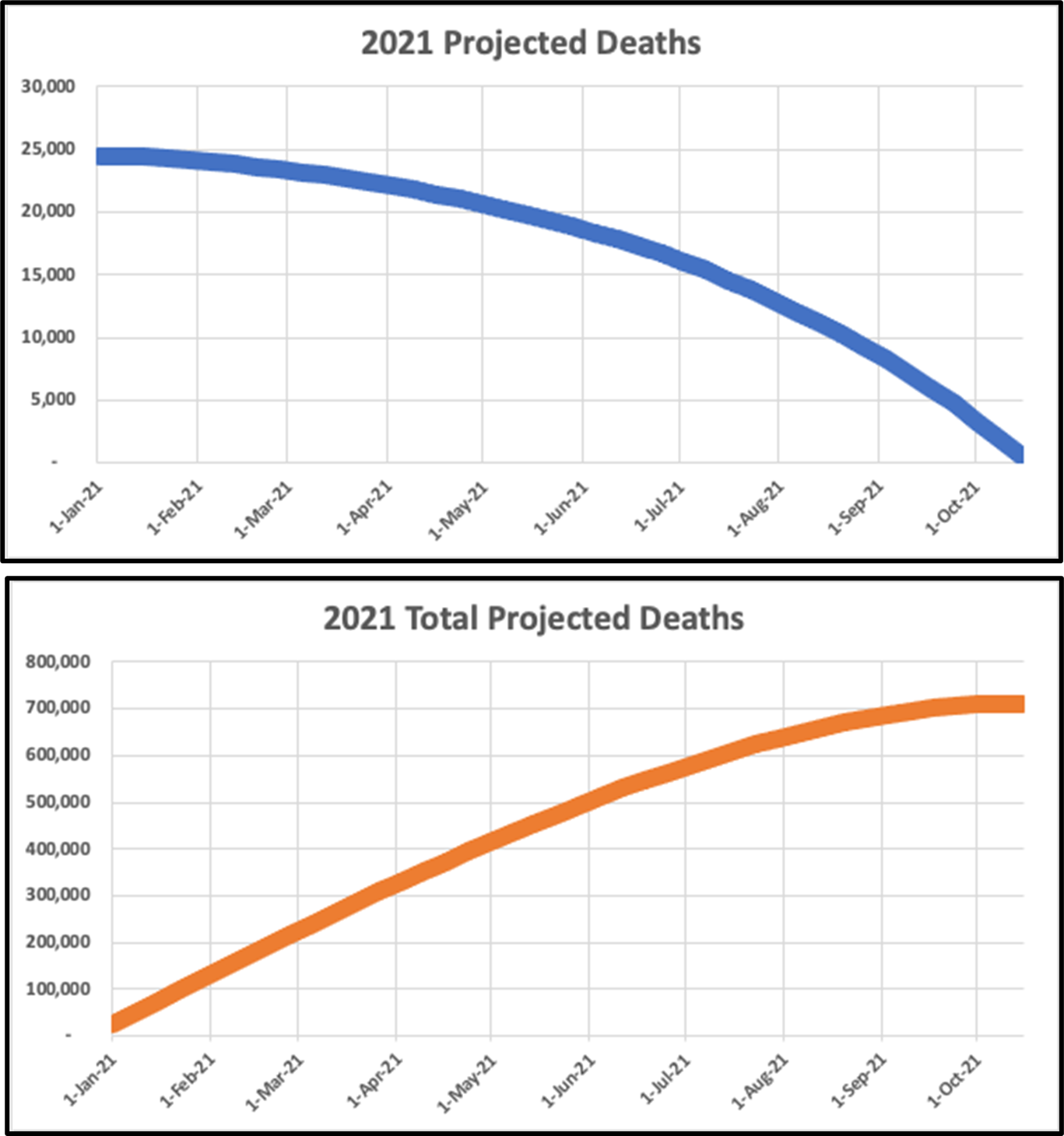
During the period between January 1 and that period in October in which we reach a level of 70% immunized people, the number of deaths that occur will be dropping each week as more and more people become immune. Weekly death rates will fall from a beginning high of 24,500 in January, to 22,000 in April, to 12,000 in August and less than 1,000 in the middle of October.
Over the period of January 1, until the middle of October, even with the expansion of vaccination programs we may expect to see an additional 700,000 deaths in this country from this disease. Including the 350,000 deaths that we will have seen in 2020, that will result in a total of a little over 1,000,000 deaths during this pandemic.
These numbers may be higher than what we will actually see if:
- The vaccination of the elderly reduces the death rate faster
- The production capacities of the vaccine manufacturers increase, allowing quicker immunization of the population
- Increased use of masks, attention to physical distancing and more restrictions on public assemblies reduce the current rate of spread.
These numbers, however, may be lower than what we actually see if:
- People resist vaccination, delaying the timeline to achieve 70% immunity
- People refuse to follow healthcare guidelines and continue to associate without masks and ignore physical distancing.
- Manufacturers encounter reagent shortages which hamper their production schedules
- Adverse healthcare events are identified within vaccinated populations that result in delays in distributing vaccines and/or in population acceptance.
This is the beginning of the end, but there will still be very significant casualties during the war.