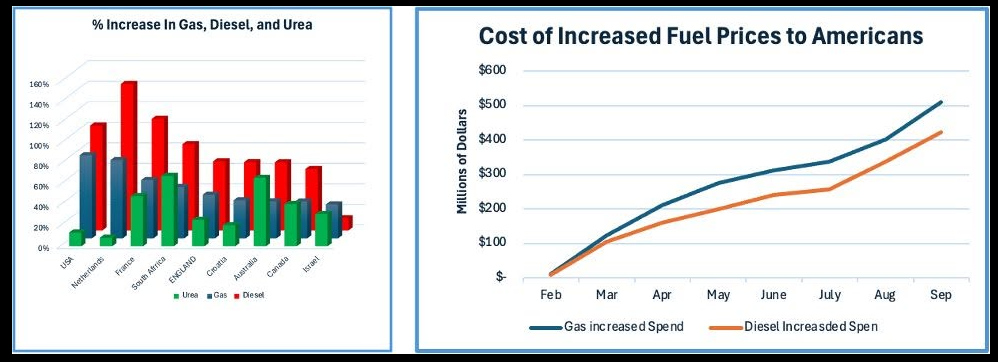
In my last essay I discussed how increased costs result in increased prices and how those increases in prices are measured by “inflation”. In this note I want to bring us all to the same page on how the inflation measured over the prior year results in increased prices going forward and will be measured as inflation in the upcoming year.
POLITICAL TOOLS TO REDUCE INFLATION
When a politician pledges to reduce inflation, he/she seldom describes how.
There are basically two tools that the government has for influencing pricing increases as measured by inflation. (I do not include price/cost controls, as these are politically distasteful).
The first tool is governmental spending. When spending increases, there is more money put into the economy. Increased money results in increased funds for purchases. Increased demand can allow companies to raise their prices. Government can add money to the economy by enacting new spending plans, or by “spending” by decreasing taxation revenues, thereby leaving additional funds in the hands of taxpayers who would have otherwise remitted those funds to the government. Either strategy results in more funds available in the hands of the population and an expected greater demand for products.
However, when tax reductions are focused on the wealthiest individuals, the equation may change. That increased “spending”, i.e., returning funds to the wealthy taxpayers, may not result in increased product demand. Instead, it may result in increased investment (savings). This will stimulate the stock market as additional funds are available for purchasing stocks. Additional investment in stocks of public companies will benefit those companies, providing them with additional funds for expansion or dividends. Therefore, to reduce the effects of adding money to the economy by spending increases, those tax cuts should be limited to the wealthiest individuals. Tax cuts to the middle class will result in increased spending rather than investment.
When governmental spending decreases, there is less money put into the economy. Less money results in lower demand and a pressure on producers to lower their prices to maintain revenues. Lower spending can reduce inflation.
We can see the current administration’s strategy as a combination of these two strategies. Reducing spending will put some pressures to lower prices and decrease inflation, while tax cuts on the segment of the population that is already maxed out in spending on products will increase investment in companies, potentially leading to expansion and increased employment.
The strategy may be solid, but the execution of it may be problematic. How one reduces spending has great consequences to the population. A debate over the spending cuts in the BBB-Act is important, but it is a topic outside this discussion.
The second tool for the government in its approach to inflation is the Federal Reserve. Raising borrowing rates tends to reduce spending. Reduced spending decreases demand. Reduced demand pressures manufacturers to lower their prices to maintain sales volumes. The opposite is also true. Reducing borrowing rates increases the ability to generate funds for purchasing, increasing demand. Increased demand generally allows manufacturers to raise prices, and the net result is increased cost-of-living, measured as higher inflation.
The current administration’s strategy of decreased spending and increased investment would not be consistent with lowering the Federal Funds rates.
HOW DOES PRICE INFLATION OCCUR?
In a capitalist system, costs and prices change based on many factors. Let’s take a look at one product and the pressures that a company faces from those increases. To do this we’ll use a reasonably simple model.
I have chosen to examine a public company that manufactures glass bottles in New Jersey. We will assume that the costs of the plant and all its equipment has already been paid for and absorbed by the company. We will also ignore the costs of transportation from that factory to the customer because those costs are independent of the manufacturer, vary based on the location of the individual customers and is generally a fixed charge absorbed by the customer regardless of the product it purchases. Those charges are added to the costs that the eventual customer realizes.
The variables in making a glass bottle include
- The material (silica sand, soda ash, and limestone)
- Skilled labor
- Energy
- Packaging
Silica Sand is sourced domestically, but it is also imported from Canada, Korea, and Brazil.
Limestone is sourced domestically, but it is also imported from Canada, Japan, and the Dominican Republic.
Soda Ash is sourced domestically, but also imported from Turkey, Mexico, the UK, and Bulgaria.
When tariffs are imposed on imported materials from these offshore sources, the costs of those materials rise. From a company’s standpoint it doesn’t matter whether they import these resources themselves, and therefore pay the tariffs directly, or whether they purchase those foreign-sourced resources from an import company who pays the tariffs and passes on those increased costs to the manufacturer. Domestic sources have historically increased their prices to meet those of the imports, so the raw materials for blowing glass bottles will increase. But even in the absence of tariffs, inflation in offshore sources results in increases in material costs also. As other countries grow their economies, they become competitive customers for these raw materials and that increased demand will also drive material prices up.
Skilled labor costs can increase as the labor force matures. Most employment contracts provide pay increases based on years of service and/or consumer price indexing and with decreased turnover, the overall costs for labor will increase.
Even turnover can be expensive though, as the savings seen in shedding older worker’s salaries will often be offset by the costs of recruiting, hiring, on-boarding, and training new hires. Furthermore, there is well-documented decreased productivity for those new hires when compared to seasoned workers.
Additionally, health insurance costs generally increase yearly, and matching contributions to retirement accounts increase along with labor costs.
Energy costs to fire the kilns and to provide cooling for the facilities can vary based on energy prices.
Cardboard packaging for bottles produced is manufactured domestically, but large amounts are imported from China, Vietnam and Mexico and are therefore, subject to tariffs also.
PRICING INCREASES AS A RESULT OF COST INCREASES
So, how does the management and Board of Directors decide on prices based on these costs? What do they do when the costs of raw materials, labor, and packaging increase? They may choose to keep their pricing constant, which will reduce their profits. They may choose to increase their pricing to offset those costs, but they need to factor in how those price increases will affect their overall sales and therefore, their overall revenue.
Profits will be viewed by investors and the market as a measure of the health of the company and lowered profits as a percentage of revenue will generally drive the price of the stock down. However, lowered revenue with continued profit ratios may also sour investors since growth is a signal measure of the company’s value.
The company will need to find a good compromise between increasing prices to offset increased costs and attempting to buffer any loss in sales.
On the other hand, energy prices also fluctuate and may actually decrease. What does the company do when their costs of energy fall? In our economic system when manufacturing expenditures decrease based on a variable cost like energy, companies generally do not decrease their price. Most companies will not vary their pricing based on fluctuations in energy costs because price increases, even if they simply are made to reverse prior cuts, are generally difficult to impose. One option when costs decrease is to offer a “sale” to customers. The decreased pricing is then seen as temporary, and since the costs have decreased, the lower pricing has little effects on actual revenue/profits measures.
Companies like this glass-blowing manufacturer, in which energy costs are a significant factor in overall product costs, attempt to buffer these changes by purchasing energy futures (contracts to purchase energy at some future date for a fixed price determined today), so, the glass bottle manufacturer is not so much affected by changes in energy costs.
The net result is that glass bottle prices will increase, albeit incrementally, over the year.
THE CONSEQUENCES OF INFLATION-GENERATED PRICE INCREASES
These increases then multiply through the economy. Any other company that uses glass bottles to package their own products will see an increase in their basic costs, and they will have to adjust their prices accordingly.
In short, multiple factors both caused by and outside of the reach of the US government can force domestic manufacturers to see an increase in their production costs. Those increases create internal pressures in companies to raise their prices, and those price increases cascade throughout the entire domestic economy.