Note: WONK ALERT. PROCEED AT YOUR OWN CAUTION!
The US National Debt is about to pass $38 Billion.
Our gut reaction is that this is terrible. The growth of the National Debt is unsustainable, and the interest payments on the debt our eating up a larger and larger fraction of the National Budget.
I have been looking at the numbers, and I have been surprised at some of the things that are there.
Here is a quick quiz:
Is the National Debt a result of revenue or spending?
- Is our National Debt large compared to other countries?
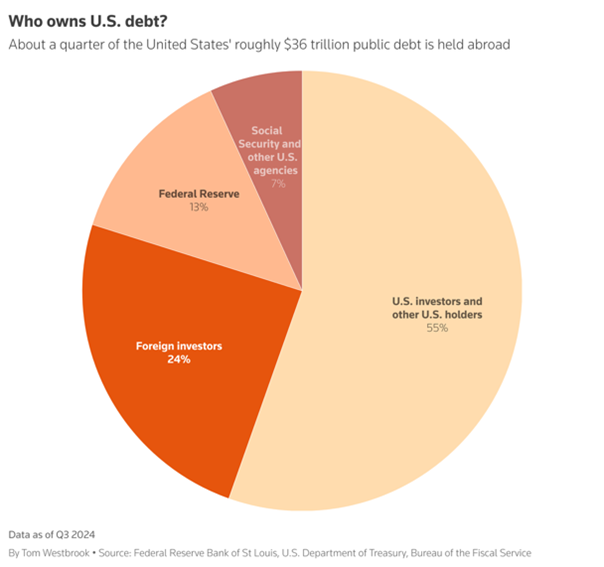
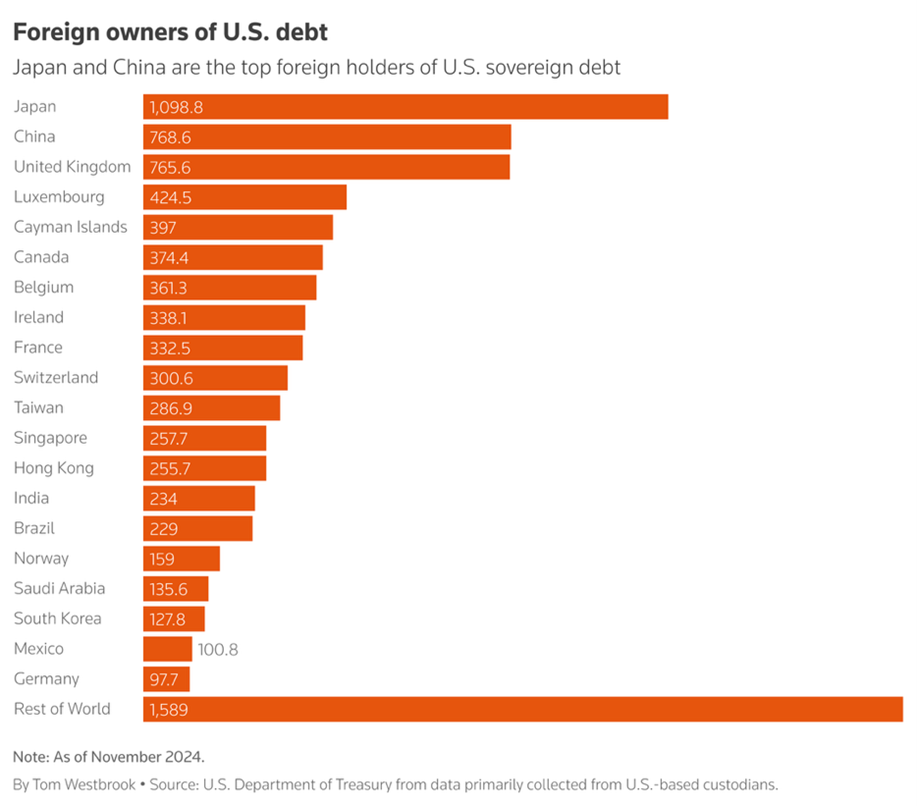
- Is our National Debt held by China?
- Has our National Debt really risen?
Let’s look at these questions.
Spending vs. Revenue.
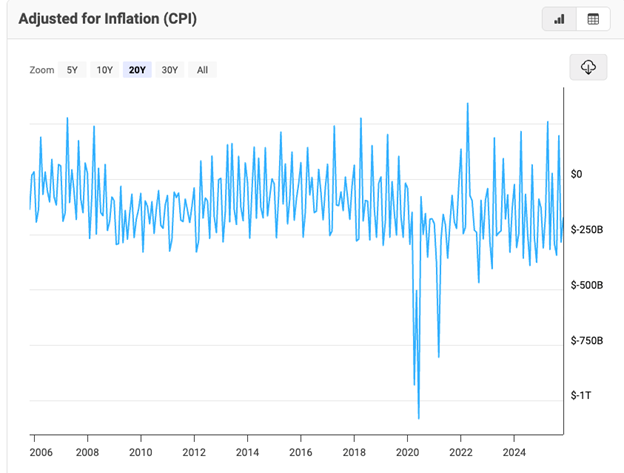
This is the core political question. In the simplest terms, the debt rises when spending is larger than revenue. Reversing those trends can reduce the debt (or at least the deficit).
On one side of the political side there is more focus on spending, and how to reduce it. But there are several factors that restrict this ability. Each side of the aisle wants to spend money, but their priorities are different. On the Republican side, increases in military spending, monies for veterans, border security and targeted infrastructure are most popular. On the Democratic side, increases in monies for the social safety net, education, infrastructure, and R&D.
Politically, it has become difficult to cut almost any of these programs. One of the things that DOGE proved is that it is difficult to trim programs with any significant reduction in costs. Most estimates of the outcomes of that aggressive program show reductions of only a few tens of billions of dollars in annual spending. DOGE also found that the government is actually surprisingly efficient, that the costs of running programs and the staffing to support those programs (enacted by Congress and signed by Presidents) are soundly well-organized. It may not fit your preconceived or preferred views, but it is, on the whole true. That does not mean that there aren’t unnecessary programs or redundant employees. After all, in any organization, public or private, there are highly productive, and less productive workers.
With respect to revenue, there is a split in the underlying philosophies of collecting taxes.
Republicans tend to believe in keeping more money in the hands of the upper-level income brackets. The argument here is that if you increase the cash for those people, the net effect will not be more spending by them, but that the additional money would then be invested in companies, either into their own or through investment in stocks or other financial instruments that empower companies to grow. The corollary is the belief that financially successful people are more likely to invest more effectively than the government.
Historically, they argue, tax cuts result in economic growth and therefore increased revenue overall to the government. This has been true for tax cuts from the post-WWII levels; however, the problem with the logic of this argument is that if you take it to its natural conclusion, cutting taxes to zero would stimulate the collection of the most revenue, and this is patently false. The truth is that, like most measurements, this is a bell-shaped curve. Cutting taxes when they are extremely high increases revenue, but the revenue increases begin to decrease at some point as taxes are reduced.
Democrats tend to believe that the US economy is consumer driven, and that putting money back into the hands of the majority of citizens will result in increased spending which will provide increased income for companies, which will, in turn, provide those companies with the resources to grow and expand. Legislation which offsets the necessary expenditures by those citizens through social safety net programs or other services frees up monies in those family budgets that are spent in the marketplace. The corollary is the belief that only the government will invest in programs that support the citizenry without an immediate ROI, and therefore, will be more beneficial overall than investing in profitable public companies.
Comparing the US National Debt to other Countries.
As of late 2025, the global GDP is around $117 trillion.
As of late 2025, the global National Debt is around $111 trillion.
As of late 2025, the global National Debt is around 95% of the global GDP.
The US GDP is about 26% of the global GDP
The US National Debt is about 34% of the global National Debt.
One useful way to look at the National Debt is to look at the Debt as a % of the National GDP for each country. This allows one to adjust the value based on the size of the economy.
Using this method, the US has a national debt equal to about 123% of its own GDP.
Only eight other countries have a higher Debt/GDP ratio, which includes Japan, Singapore, Greece and Italy. Close behind are France, Canada, and the UK.
The Euro Zone in total has a National Debt of 90% compared to its GDP.
First Conclusion:
The US National Debt is high, but not extremely higher than other industrialized countries.
As of late 2025, global national debt sits around $111 trillion, equating to roughly 94.7% of the world's total GDP
US national Debt: $38 Trillion = 34% of global national debt
US GDP = $31 Trillion = 26% of global GDP
|
National Debt |
Inflation Rate |
National Debt adjusted for Inflation |
|
|
$37,637,553,494,936 |
2.9 |
$36,918,725,560,268 |
|
|
2024 |
$35,464,673,929,172 |
4.1 |
$35,820,720,768,301 |
|
2023 |
$33,167,334,044,723 |
8.0 |
$32,382,570,459,132 |
|
2022 |
$30,928,911,613,307 |
4.7 |
$28,770,065,592,889 |
|
2021 |
$28,428,918,570,049 |
1.2 |
$27,430,408,236,118 |
|
2020 |
$26,945,391,194,615 |
1.8 |
$23,264,667,395,516 |
|
2019 |
$22,719,401,753,434 |
2.4 |
$21,967,895,405,027 |
|
2018 |
$21,516,058,183,180 |
2.1 |
$20,508,083,716,262 |
|
2017 |
$20,244,900,016,054 |
1.3 |
$19,593,018,158,651 |
|
2016 |
$19,573,444,713,937 |
0.1 |
$18,441,027,549,148 |
|
2015 |
$18,150,617,666,484 |
1.6 |
$18,091,432,451,445 |
|
2014 |
$17,824,071,380,734 |
1.5 |
$17,089,685,380,758 |
|
2013 |
$16,738,183,526,697 |
2.1 |
$16,580,361,132,422 |
|
2012 |
$16,066,241,407,386 |
3.2 |
$15,026,985,773,814 |
|
2011 |
$14,790,340,328,557 |
1.6 |
$13,507,376,538,768 |
|
2010 |
$13,561,623,030,892 |
-0.4 |
$12,362,402,505,645 |
|
2009 |
$11,909,829,003,512 |
3.8 |
$10,305,417,194,026 |
|
2008 |
$10,024,724,896,912 |
2.8 |
$9,295,898,280,175 |
|
2007 |
$9,007,653,372,262 |
3.2 |
$8,796,211,011,789 |
|
2006 |
$8,506,973,899,215 |
3.4 |
$8,146,892,822,590 |
|
2005 |
$7,932,709,661,724 |
2.7 |
$7,548,770,908,346 |
|
2004 |
$7,379,052,696,330 |
2.3 |
$6,891,762,759,748 |
|
2003 |
$6,783,231,062,744 |
1.6 |
$6,402,626,572,634 |
|
2002 |
$6,228,235,965,597 |
2.8 |
$6,004,917,168,215 |
|
2001 |
$5,807,463,412,200 |
3.4 |