Ripping us off
Note: I am not an economist. If I have made errors here, I hope those of you who are economists will correct them.
I have previously written about the bogus calculations that the White House Office of the Trade Representative made to determine what tariffs should be levied on what countries. What looked like a complicated economic equation turned out to be a self-forged piece of nonsense that has no basis in econometrics and simply disguises their intended use of the trade deficit as something scientific and academically difficult to understand.
Let’s take a look at the illogic behind this mathematical snake oil.
We can use the EU as an example.
From the fancy chart that Mr. Trump held up when announcing these tariffs, the “EU Tariffs charged” to the USA are 39%, so the “USA Reciprocal Tariffs” will, generously be only 20%.
According to the White House calculations, in 2024 we ran a trade deficit with the EU of $236 billion. (But, and this is really important, that $236 billion is the trade deficit of GOODS ONLY. It does not include services, and we will discuss that a little more below).
In 2024 the US imported $606 billion in goods from the EU and exported $370 billion to them. So, the deficit in goods was $236 billion. Take that number and divide it by the total imported ($606) and, ta da, you get 39%! That is NOT a tariff that the EU puts on US goods, it is just the % of the difference in total goods exchanged. There had been tariffs imposed by the EU on US imports and by the US on EU imports in 2024; however, those tariffs were less than 5% and the differential between the EU tariffs and the US tariffs was about 1%.
Do not be confused by some of the other things being thrown around to cloud up your thinking. The EU, in fact, DOES tax the goods that are imported from the USA; but that tax is imposed on ALL goods sold in the EU, from wherever they come, inside the EU or outside it. This tax is called a VAT (Value Added Tax) and varies between countries, averaging just over 20% across the entire EU. That is a tax on EVERYTHING. If you have gone to Paris and bought items at Galeries Lafayette, you know that you can get the VAT returned to you when you fly home.
This is not a tariff on US imports, it is a tax on anything sold to anyone, anywhere in the EU. The same tax on California wine as on French or German wine.
So, at first base, the idea that the EU charges tariffs on US imports at a rate of 39% is not only false and misleading, but it also suggests that the people stating this have no understanding about economics at all or are intentionally lying about it.
At second base, the idea that the consumer tax imposed by the VAT is somehow specific to US goods is also either a total misunderstanding of economics or an intentional lie.
Finally, at third base, a large factor in trade was completely excised from these calculations – SERVICES.
Now, you may think that services are some small amounts of non-essential things that really don’t matter in trade. You would be wrong.
“Goods” are tangible items that satisfy people's wants, like physical objects you can purchase and own.
“Services” are acts for which a consumer, company or government is willing to pay.
Here is a “small” list of services that contribute to trade (not my list, the actual list).
Functions like Consulting, Customer Service, Dispute Resolution, Arbitration, Negotiation, Diplomacy, Courts, Incarceration, Law Enforcement, Lawyers, Military, Education, Libraries, Museums, Schools, and Human Resources
Financial Services like Accountants, Banks, Real Estate, Stockbrokers, Tax Services, Valuations
Entertainment services like Casinos, Gambling, Gaming, Movies and Movie Theatres, Performing arts, Sports, Television and Radio
Construction services like Carpentry, Electricians and Plumbers
Repair and Maintenance services like Janitors, Gardeners, Dry Cleaning, Laundry, and Mechanics
Public Utilities like Electric Power, Natural Gas, Telecommunications, Waste Management, Water Industry,
Personal services like Foodservice, Health Care, Hospitality, Information services, Data processing, Interpreting, Translation, Transport, Warehousing, Stock Management, Packaging, Body hair removal, Dental Hygiene, Hairdressing, Mani-Pedi, Insurance, Security, Social Work, Childcare, Elderly Care
There are a lot more services bought and sold than you might have imagined!
And it turns out that the USA exports more Services than it imports!
In the EU that surplus is over $100 billion. And now if you use the same calculator as the Trump Administration used to calculate the “tariff” deficit with the EU, you get 19%, or half what they would like to claim. I would suspect that if the EU were to put tariffs on services imported from the US in order to stimulate the purchase of those services locally, this administration would not react in a friendly fashion, nor would our banks, entertainment businesses, telecommunications, foodservice companies, etc.
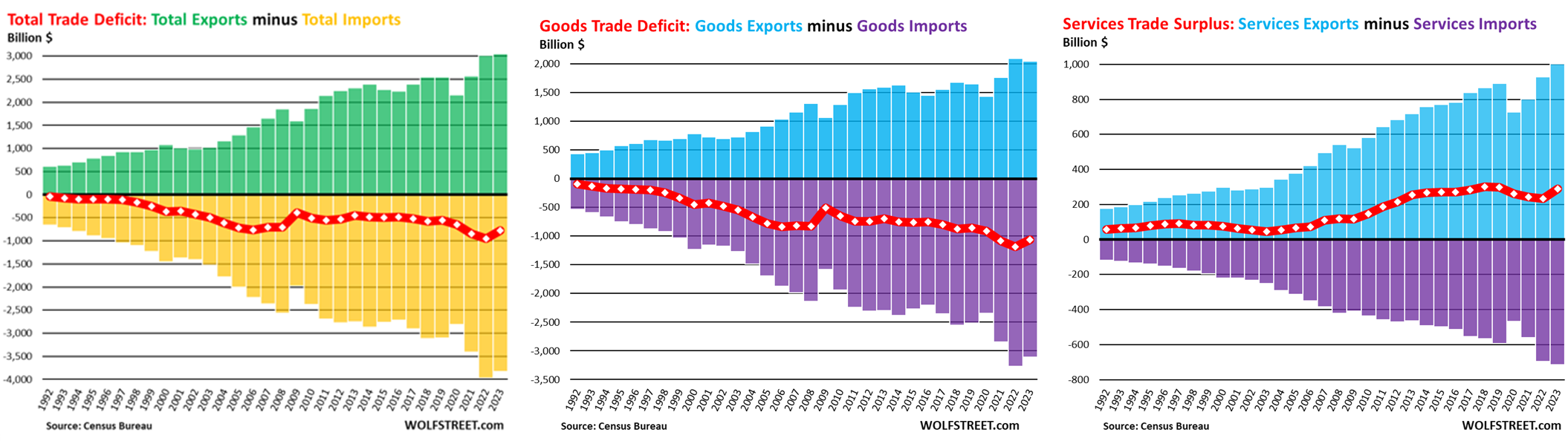
Attached here is the chart that the administration does not want you to see. It has 3 panels. The first panel shows the total trade deficit over the past 20 years. You can see that the deficit has increased (the curve is going down, widening the gap) but shows signs of leveling off. The second panel is the only one the current administration focuses on. The trade deficit of goods has indeed increased over this period, but in the third panel we can see that over the same period the trade surplus in services has increased.
Now, think about those trade deficits in goods. The argument being made is that tariffs will encourage expansion of manufacturing in this country. But what manufacturing is actually able to return, and do we actually want it, or can we afford it?
Products requiring the highest percentage of manual labor often fall within manufactured goods such as bricks, garments, textiles, footwear, and carpets. Do we expect to revive the manufacturing of these items in this country? If manual labor is required, how can we compete internationally?
It is estimated that US households in the bottom 2 quintiles (the bottom 40% of the population) earn between $28,000 and $44,000 per year. In Mexico, the average wage for a worker is $20,000 per year, and overall, in the world, the medium income is less than $3,000 per year.
In the US, in 2023, the gross annual wage for full-time employees was $80,000 per year.
For the US to compete in manufacturing of items that require large amounts of manual labor, we would need to meet the wages of other countries or force those countries to increase their pay to meet ours. Those are highly unlikely occurrences.
But, you say, those are not the manufacturing jobs we need to create, we need to create those that require higher paying employees, jobs in automated factories with state-of-the-art equipment. This is a problem also.
I have had a lot of experience in making plastic parts. The molds to make injection-molded plastic parts are expensive, and they are made in this country as well as in several other international locations. The companies in this country are at or near capacity, so to purchase molds to make parts in your factory you will need to go overseas. The time frame for ordering a mold would include:
1 month for designing the mold and creating manufacturing drawings and specs.
4 months for having the mold made (assuming there is room in the production schedule)
1 month for testing the mold and finding run parameters.
3 months for scaling up to create inventory for your new factory.
That means that if you can get an engineering firm who specializes in plastic injection molding design to design a part to your specs, and if you can find a mold manufacturer who can get you into their schedule, and if you can ship the mold to your molding factory, you can do that in about 9 months.
And that is only for 1 of probably dozens of parts necessary to make your product.
You also need to purchase the injection molding machines. They need to be made for you, there is no inventory for you to buy off-the-shelf. This may take up to a year or more. You may try to contract with a custom molding company who would run your parts for you, but there is a shortage of those companies and it is difficult to find space in their schedule.
You well also need to purchase the raw materials, colorants, additives, etc. to allow your machines to make your parts in your molds.
The costs of these items need to be determined, and if those are imported, they will have a tariff on them. The overall costs will determine your operating expenses. If you believe that after calculating the amortization of the factory, the cost of acquiring the labor needed and their training, any costs for procuring a site for your factory, etc. that your product will be competitive, you need to determine if the tariffs that provided the margin for you to compete with imported products will exist at the time that your factory is ready to make product, or if they will have been negotiated away during the ramp-up period, or eliminated as political winds change.
Everyone would love to find an easy answer to difficult questions. But they are difficult BECAUSE they don’t have easy answers.
In a capitalist economy, the pressure on the businessman is to make the best product he can, with the most appeal to the consumer, at the lowest possible price and the highest possible profit. Those companies that choose to ignore those principles will fail. If a part, or product is available offshore at a better price, or better quality than what you can get locally, any capitalist will purchase that product offshore. If your purchasing department did not do that, they would be fired.